Two-Way Audio CCTV Camera: Why Talking Back Beats Just Recording
Kushal Sanghvi
Updated●July 22, 2026
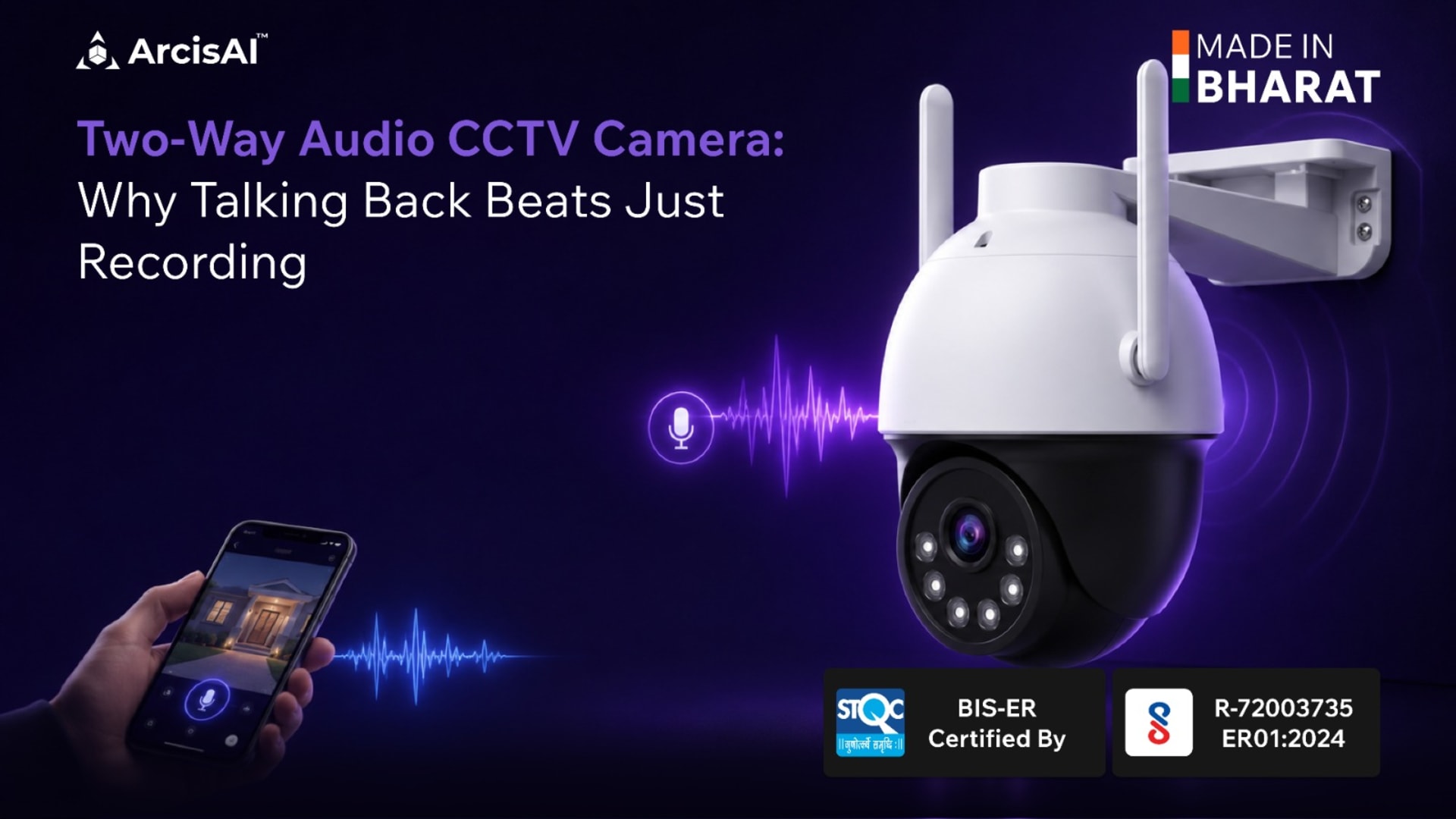
Most CCTV cameras only do half the job. They watch, they record, and then, if something goes wrong, someone reviews the footage afterward to work out what happened.
By the time that review happens, the moment is over. The guard who could have moved someone along never got the chance to say a word. The shop owner who could have called out to a customer near the till was busy somewhere else. The parcel sitting exposed at the gate had already been picked up before anyone noticed the delivery agent standing there.
A two-way audio CCTV camera closes that gap. Instead of only capturing what happened, it lets you listen to a space and speak into it in real time, from an app, from anywhere. This guide explains what two-way audio actually means on a camera, why it changes the outcome of an incident rather than just the record of one, and what to check before you buy so the feature works the way you expect once it is mounted.
What a Two-Way Audio CCTV Camera Actually Is
What a Two-Way Audio CCTV Camera Actually Is
A two-way audio camera has a built-in microphone and speaker alongside its lens. That combination lets you do two things over the same live connection: hear what is happening at the camera's location, and speak back through it, so the person on the other end hears you.
Both directions run through the camera's app, over the same network connection the video already uses. There is no separate intercom system to wire in and no extra hardware to mount next to the camera. The audio channel travels with the video feed.
This is different from a camera that only records ambient sound alongside its footage. A microphone that logs audio for later playback tells you what was said after the fact. Two-way audio lets you say something while it still matters.
The Gap Between Recording and Responding
The Gap Between Recording and Responding
A recording is evidence. It tells you what went wrong, who was involved, and when it happened, and that has real value for an investigation or a dispute.
But a recording cannot stop anything. It arrives after the outcome is already fixed. Two-way audio sits earlier in that timeline. A guard watching a restricted zone does not have to walk over to move someone along, a word through the camera does that. A shop owner does not have to leave the counter to greet a customer standing near a display, a quick word through the camera handles it. A homeowner does not have to leave a parcel exposed at the gate while a delivery agent waits, one sentence settles it.
None of that needs a person physically present at the location. It only needs a camera that can talk as well as watch.
Every Camera in the Range, Not Just One Model
Every Camera in the Range, Not Just One Model
Two-way audio is often built into only one camera in a range, typically a PTZ covering a large site, while the smaller cameras watching a shop counter or a clinic desk stay watch-only.
That split misses where the feature is most useful. A boutique, a clinic, or a small office benefits from a live voice channel just as much as a large perimeter, often more, because those are the sites where nobody is stationed to react in person. Checking on a delivery at the front gate, guiding a courier to the right entrance, or reassuring someone waiting at a reception desk are everyday moments, not rare security events. The type of location a camera covers should decide its form factor: a weatherproof bullet at a fence, a discreet dome in a retail aisle, a wide-panning PTZ over a yard. It should not decide whether that camera can talk.
What to Check Before You Buy
What to Check Before You Buy
Not every camera marketed with a microphone and speaker performs the same once it is mounted and running. A few checks before purchase save most of the disappointment.
Start with whether the feature works both ways from the app. Listening in only is a different, lesser feature than genuine two-way audio, so confirm you can speak back and be heard clearly at the camera end. Next, check whether it is available across the range you actually need, a bullet, a dome, and a PTZ, rather than locked to one model, since a site rarely uses only one camera type.
Then look at what you can actually see before you speak. Talking to someone only matters if you can identify them first, so a camera with weak night vision undermines the feature after dark, exactly when it matters most. Confirm the camera runs on ONVIF and integrates with a proper VMS or app, since a live audio channel is only as useful as the software that lets you reach it quickly when something is happening. Finally, for any site with formal procurement requirements, confirm certifications: a STQC certified CCTV camera and a BIS-ER certified brand clear compliance checks that an unverified import cannot.
Run through those points and you will know whether a camera genuinely gives you a live voice channel or just a speaker that logs sound for later.
Two-Way Audio Across the ArcisAI Eco-Series
Two-Way Audio Across the ArcisAI Eco-Series
This is exactly the gap the ArcisAI Eco-Series was built to close. Two-way audio, sold as Talk Back, runs on every model in the range, the Bullet, the Dome, the PTZ, and the compact Baby PTZ, rather than being reserved for one flagship unit.
Each camera pairs that live audio channel with color night vision and infrared, so you can identify who you are talking to at noon or well after dark, and everything connects through the STQC certified ArcisAI Cloud VMS and app, which means one operator can watch, listen to, and talk to multiple sites from a single screen.
On compliance, the Eco-Series is engineered and built in India, runs on non-Chinese components in line with NDAA Section 889 expectations, and is backed by BIS-ER certification alongside the STQC certified VMS. For buyers moving away from unverified imports or comparing against premium Western brands, that combination of a genuinely live audio feature and a certified, made-in-India build is the point.
The Takeaway
The Takeaway
The value of a camera is not only in what it records, it is in what it lets you do while something is still happening. A recording tells you what went wrong. A voice can change the outcome before it does.
A two-way audio CCTV camera turns a passive lens into a way to be present at a site you are not physically standing in, and that capability should not depend on which model you bought. Whether it is a gate, a shop counter, or a small clinic desk, the ability to speak through the camera belongs at every price point, not just the top of the range.
Want to see Two-Way Talk Back live on your own site?
Book a free demoFrequently Asked Questions