School Surveillance System: A Campus Security Guide
Kushal Sanghvi
Updated●August 5, 2026
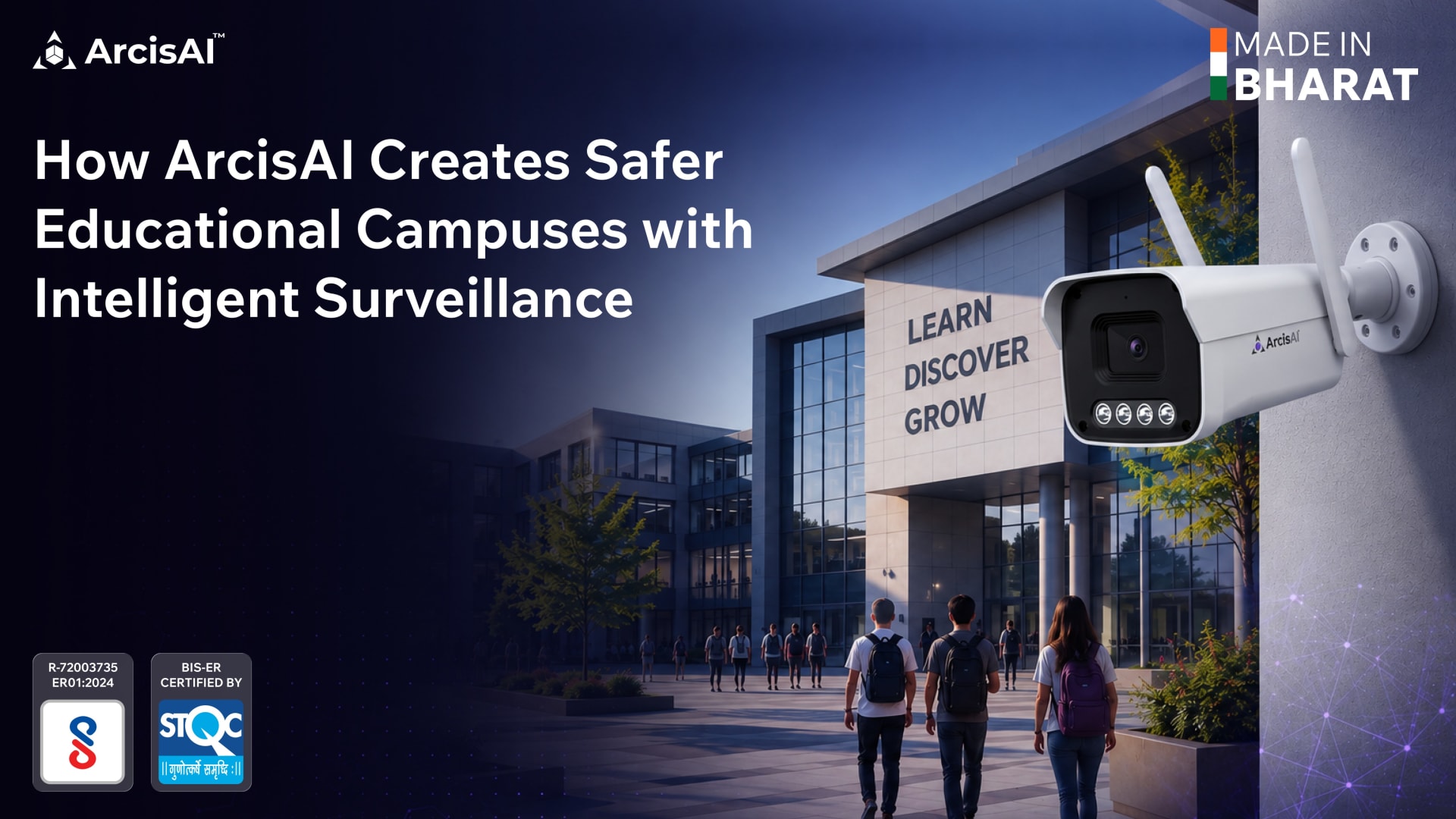
A gate left unmonitored during dismissal. A visitor who walked past reception without signing in. A camera that was recording the whole time, but nobody saw the incident until a parent asked for the footage the next morning. For most schools, this is not a hypothetical. It is what a "security camera system" quietly turns into once the excitement of installation day wears off: hours of stored video that nobody has time to watch, and a gap between something happening and someone finding out.
Unsupervised corners of a large campus, side entrances that see more traffic than the front gate, and incidents that get discovered only after the fact all add up to the same anxiety for administrators and parents alike: is anyone actually watching, or just recording? A school surveillance system built for real-time awareness, not just storage, is what closes that gap.
Table of Contents
Why Campus Security Is Different From Standard CCTV Use Cases
What a Modern Campus Surveillance System Should Do
Common Gaps in Traditional School CCTV Setups
Key Features Schools Should Look For
Where ArcisAI Fits In
Certifications That Matter for Government and Aided Institutions
Getting Started: What Schools Should Do Next
Why Campus Security Is Different From Standard CCTV Use Cases
A school is not a warehouse or a retail store, and treating it like one is where a lot of campus CCTV projects go wrong.
Most campuses have several entry and exit points, not one controlled door: a main gate, a staff entrance, a sports ground gate, sometimes a service lane for deliveries. Every one of those needs coverage, and every one is a place where an unauthorized entry can happen without anyone noticing in real time.
The people managing the system day to day are usually not technical staff. A front-office administrator or a facilities head, not an IT team, is often the one expected to check footage or respond to an alert, so the system has to be simple enough for a non-specialist to use under pressure.
The stakes are also different. When the people on camera are children, delayed detection is not just a security lapse, it is a child-safety issue, and it is the reason parent and administrator anxiety around campus surveillance runs higher than it does for a typical commercial property.
And most schools, government-aided or private, are working within a defined budget, not an open-ended security spend. Whatever gets recommended has to hold up against all four of these realities at once, not just one of them.
What a Modern Campus Surveillance System Should Do
Strip away the specific brand and the checklist for a genuinely useful school surveillance system looks fairly consistent.
It should raise a real-time alert when something needs attention, not just log it for someone to discover later. A person entering a restricted zone, a gate opening outside school hours, or a camera being blocked should trigger a notification the moment it happens, not sit buried in hours of recording.
It should cover the campus as zones, not just as individual cameras. Perimeter fencing, entry gates, playgrounds, corridors, and parking areas each carry a different kind of risk, and a system that treats them as one undifferentiated feed misses the point of zone-based monitoring.
It should track visitors as they move through the property, not just record that a person walked past a lens. Knowing who entered, when, and through which gate matters more on a school campus than almost anywhere else.
And it should give administrators remote access, so a principal or facilities head can check any gate or corridor from a phone without being physically present at a control room, and can do the same after hours if something looks off.
Common Gaps in Traditional School CCTV Setups
Most schools already have cameras. Very few have a system that actually does the four things above, and the gap usually comes down to a handful of recurring problems:
- Passive recording only. The cameras capture footage, but nothing about the system actively watches it. An incident gets confirmed by scrubbing through hours of video after a complaint, not flagged as it happens.
- No real-time alerts. Without them, "24x7 surveillance" really means "24x7 storage," and the difference matters enormously when every minute of delay is a minute someone could have intervened.
- Poor coverage. This is often by design rather than neglect, because budgets get spent on the main gate and the obvious hallways while side entrances, boundary walls, and parking areas end up as blind spots.
- No tamper protection. A large share of school CCTV setups have none at all, which means a camera that has been covered, turned, or disabled simply stops working, with nothing flagging that the blind spot now exists.
Key Features Schools Should Look For
Given those gaps, a handful of features separate a system that genuinely improves campus safety from one that just checks a compliance box.
Human and Motion Detection
A camera that can distinguish a person from a leaf blowing across the frame is the difference between a useful alert and a stream of false ones. On-camera human detection means a restricted-zone breach or an after-hours entry gets flagged as it happens, not discovered later.
Tamper Detection for Vandalism-Prone Areas
Playgrounds, boundary walls, and stairwells are the areas most likely to see a camera covered, sprayed, or knocked out of position. Tamper detection flags exactly that moment, so a disabled camera becomes a visible alert instead of a silent gap in coverage.
Remote Monitoring for Non-Technical Staff
A system is only as useful as the person checking it can operate. Remote monitoring through a simple mobile app, rather than specialized control-room software, means a front-office administrator or facilities head can check any gate or corridor from a phone, without needing IT support to do it.
ONVIF and Integration Flexibility
Many schools already have some cameras or a recorder in place. A system built on the ONVIF open standard can add new cameras to that existing setup instead of forcing a full replacement, which matters directly for a budget-constrained institution.
Certified Hardware
For any school working with government aid, a PSU-run trust, or GeM procurement, certification is not optional. Hardware that is BIS-ER certified and paired with STQC certified video management software clears the compliance bar that gets checked before anything else does.
Where ArcisAI Fits In
This is exactly the layer the ArcisAI ECO-Series is built for. The range is designed as a rugged, campus-ready option rather than a bare-bones camera, with on-camera human detection and tamper detection built in at the hardware level,
The ECO-Series comes in PoE and WiFi variants across multiple resolutions, so a campus with mixed wiring, from a wired admin block to a distant sports ground gate, can be covered without one connectivity type forcing a compromise elsewhere. It is also ONVIF compatible, which means a school with an existing NVR or a handful of working cameras can extend the system rather than rip it out and start over.
For remote monitoring, ArcisAI's mobile app and Cloud VMS put live view, alerts, and recorded playback from every connected camera in one place, so a principal or facilities head has the same visibility from a phone that they would standing at the gate. And because the ECO-Series, the Bridge Device for legacy cameras, and the Cloud VMS are all part of one ArcisAI ecosystem, a school can start with the cameras that matter most and add to the system later without discarding what it already installed.
Certifications That Matter for Government and Aided Institutions
For government schools, aided institutions, and PSU-run campuses, certification is often the first filter a vendor has to pass, well before features get discussed. ArcisAI hardware is BIS-ER certified, and the Cloud VMS behind it is separately STQC certified, which is the pairing that GeM listings and tender documents typically ask for.
ArcisAI is also manufactured in India with no high-risk foreign components, which matters for institutions that need to document their supply chain for an audit, not just install a working camera. For a school evaluating vendors against a compliance checklist, an STQC certified CCTV system from a BIS-ER certified, made-in-India brand is the baseline that gets a proposal past procurement, before it even gets compared on features.
Getting Started: What Schools Should Do Next
Before choosing a vendor, work through these steps:
- Map every entry point, not just the main gate, and note which ones currently have no coverage at all.
- Identify who will check alerts day to day. That determines whether the system needs to be simple enough for a front-office administrator or built for a dedicated security team.
- Check what you already have. If the campus already has cameras or a recorder in place, confirm whether they support ONVIF before assuming a full replacement is necessary.
- Confirm certification upfront. If the school falls under government aid or PSU management, ask any vendor for BIS-ER and STQC certification early, since it will be asked for eventually regardless of when it comes up.
Ready to see how this looks on your own campus? Book a free demo at arcisai.io and walk through which ArcisAI ECO-Series setup fits your gates, corridors, and budget.
Frequently Asked Questions
Table of Contents
Why Campus Security Is Different From Standard CCTV Use Cases
What a Modern Campus Surveillance System Should Do
Common Gaps in Traditional School CCTV Setups
Key Features Schools Should Look For
Where ArcisAI Fits In
Certifications That Matter for Government and Aided Institutions
Getting Started: What Schools Should Do Next
Send Us a Message