How to Evaluate an AI CCTV Brand in India (2026)
Kushal Sanghvi
Updated●June 2, 2026
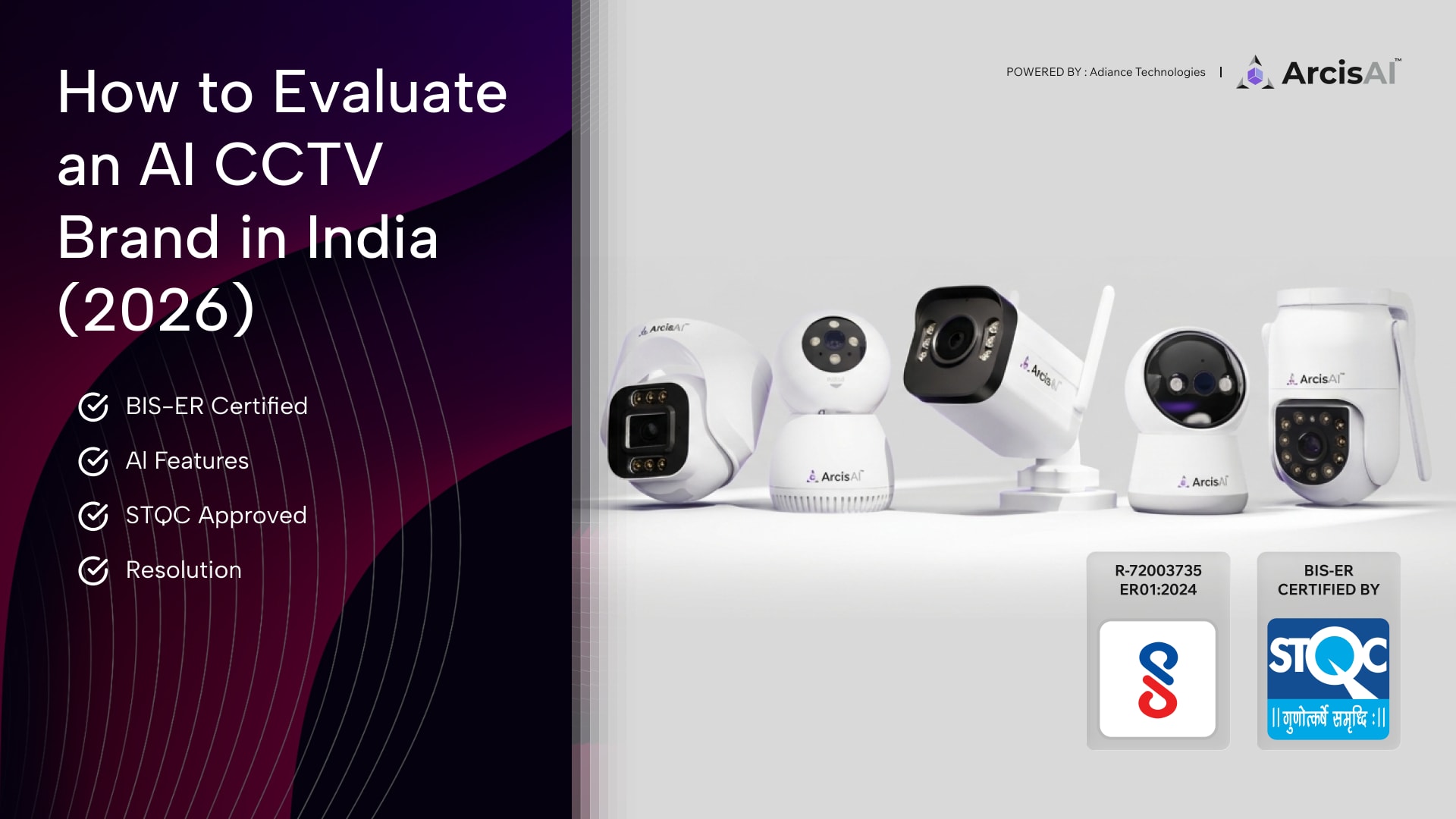
Quick answer: To choose the best AI CCTV camera brand in India, evaluate vendors across ten dimensions: BIS-ER hardware certification plus STQC-certified VMS software, edge AI capability, Made-in-India and NDAA compliance, ecosystem completeness, retrofit options, manufacturing heritage, support network, multi-site scalability, data-hosting controls, and total cost of ownership. Use the scoring checklist below to rank any brand objectively.
Why Does Brand Selection Matter More Than Individual Camera Specs?
Buying a single camera is straightforward. Deploying surveillance across a factory campus, a retail chain, or a government facility is a different challenge entirely. A great camera paired with a poor Video Management System (VMS), absent local service, or unverified certifications can leave you with an expensive liability instead of a security asset.
Brand evaluation shifts the question from "which camera has the best spec sheet?" to "which company can I trust to keep my sites secure, compliant, and supported over the next five years?" That framing leads to far better purchasing decisions.
This framework is vendor-neutral: ten measurable criteria and a scoring checklist you can apply to any brand you are considering.
What Are the Ten Criteria for Evaluating an AI CCTV Brand?
1. Certification Depth — Does the Brand Cover Hardware AND Software?
The most commonly overlooked distinction in the Indian market is that BIS-ER and STQC are two separate certifications covering two different layers of your system.
BIS-ER (Bureau of Indian Standards — Electronics & IT Goods Mandatory Registration) covers the physical camera hardware: safety, electromagnetic compatibility, and manufacturing standards. You can verify any BIS registration number on crsbis.in.
STQC (Standardisation Testing and Quality Certification) covers VMS software: security testing, source-code review, and data-handling practices. For WiFi and cloud-connected cameras — where the software layer controls remote access, live streaming credentials, and cloud data routing — STQC certification on the VMS is especially critical. An uncertified VMS is the attack surface no spec sheet will warn you about. Verify STQC certifications at stqc.gov.in.
A brand that holds only BIS-ER (hardware) but not STQC (VMS) has a gap at exactly the point where modern threats are most likely to enter.
What "good" looks like: Both BIS-ER registration (with a verifiable registration number) and STQC certification for the VMS, independently verified on government portals.
2. AI Capability — Edge vs. Cloud, and Which Detections Actually Matter?
"AI camera" is one of the most overused phrases in surveillance marketing. Probe deeper with two questions:
• Where does the AI run? Edge AI processes video on the camera's own processor — detections happen in milliseconds, work during network outages, and avoid sending raw video to a server. Cloud AI depends on a continuous upload link and introduces latency. For most deployments, edge AI is the more resilient architecture.
• Which detections are useful for your use case? A camera that does motion detection is not meaningfully "AI." Look for object classification (person, vehicle, package), intrusion detection, loitering alerts, crowd density, fire/smoke detection, and behavioural analytics relevant to your sector.
What "good" looks like: Documented edge-AI detections with at least five to eight specific use cases listed, clear disclosure of which analytics run on-device vs. in the cloud, and a roadmap for new capabilities.
3. Made-in-India and NDAA Compliance — Why Does Origin Matter?
For government projects, PSUs, defence-adjacent facilities, and export-facing organisations, two compliance dimensions are non-negotiable:
• Made in India / ALMM: Products qualifying under the Approved List of Models and Manufacturers get preference in government tenders. Genuine domestic manufacturing — not just assembly — signals a stable, auditable supply chain.
• NDAA Section 889 compliance: US law prohibits federal procurement of surveillance equipment from certain manufacturers. Indian firms working with US-headquartered clients or selling into US markets increasingly face this requirement in supply-chain audits. A NDAA-compliant brand avoids those procurement blockers before they arise.
What "good" looks like: Documented domestic manufacturing (not just "assembled in India"), a PLI or ALMM listing where applicable, and an explicit NDAA-compliance statement from the vendor.
4. Ecosystem Completeness — Cameras Alone Are Not a Solution
A reliable AI surveillance deployment requires every layer to interoperate cleanly: cameras, NVR/DVR hardware, VMS software, analytics engine, and — increasingly — a GenAI layer for natural-language querying of footage and events. When these components come from different vendors, integration complexity, finger-pointing during outages, and firmware incompatibilities multiply.
What "good" looks like: One vendor offering cameras, NVR, VMS, and analytics under a single support contract, with a documented API for third-party integrations and a GenAI layer for operator-facing intelligence.
5. Retrofit and Upgrade Path — Can the Brand Work With What You Already Have?
Ripping out existing infrastructure to adopt a new platform has a cost that rarely appears in the initial quote. Brands that offer bridge devices — hardware or software adapters that bring older analog or third-party IP cameras into the same AI management platform — dramatically reduce deployment cost and disruption for established sites.
What "good" looks like: A documented retrofit device or adapter, compatibility listed for major third-party camera brands, and a phased upgrade programme rather than a forced full replacement.
6. Manufacturing Heritage and R&D — How Long Has the Brand Been at This?
Surveillance is a long-cycle investment. A brand founded last year around a rebranded off-the-shelf camera module carries a different risk profile from one with decades of R&D, filed patents, and engineering staff focused on product development.
What "good" looks like: Five-plus years of documented surveillance product history, in-house hardware and software R&D, and evidence of ongoing investment (new models, firmware updates, filed patents).
7. Service, Warranty, and Support Network — Who Comes When Something Breaks?
A camera that fails in the middle of the night on a remote site is only as good as the service response behind it. Evaluate the actual support network: number of authorised service centres, response-time SLAs, on-site vs. depot repair, warranty duration, and whether the local dealer is trained or simply a reseller.
What "good" looks like: Minimum three-year warranty, pan-India authorised service network with documented SLAs, dedicated technical support, and clear escalation paths for enterprise accounts.
8. Scalability and Multi-Site Management — Does It Grow With You?
A system that works beautifully for a single 32-camera site may collapse under the management overhead of a 50-site retail chain. Evaluate the VMS architecture for centralised multi-site dashboards, role-based access control, remote health monitoring, and bandwidth-efficient video retrieval.
What "good" looks like: Multi-site deployment references, a VMS that supports hundreds of cameras without linear hardware scaling, and built-in tools for remote firmware updates and health monitoring.
9. Data Hosting and Privacy Controls — Where Does Your Footage Actually Live?
This criterion has grown sharply in importance as cloud-connected cameras proliferate. Key questions: Does footage leave India? Who holds the encryption keys — you or the vendor? What is the data-retention and deletion policy? Is the cloud infrastructure on Indian servers compliant with the applicable data-protection framework?
What "good" looks like: India-domiciled storage (or on-premises options), customer-controlled encryption keys, documented retention and deletion policies, and controls aligned with India's Digital Personal Data Protection Act.
10. Total Cost of Ownership — Looking Beyond the Camera Price Tag
The camera price is typically a small fraction of five-year system cost. Factor in: VMS licensing (per-camera or per-site), annual maintenance contracts, storage (local NVR vs. cloud), and upgrade pricing for new AI features.
What "good" looks like: Published, predictable licensing; all-inclusive AMC option; storage cost reference; and a clear policy for feature updates (included vs. paid).
Evaluation Criteria Summary Table
# Criterion What "Good" Looks Like Red Flags
1. Certification depth — BIS-ER + STQC (both verifiable on govt portals) — Hardware cert only; no STQC on VMS
2. AI capability — 5–8+ edge detections; documented on-device vs. cloud split — "AI-ready" with no specifics
3. Made-in-India + NDAA — Domestic manufacturing, ALMM/PLI listed, NDAA statement — "Assembled in India" with imported modules only
4. Ecosystem completeness — Cameras + NVR + VMS + analytics + GenAI under one roof — Camera-only brand with OEM VMS
5. Retrofit/upgrade path — Bridge device for legacy cameras; phased upgrade plan — Forced full replacement required
6. Manufacturing heritage — 5+ years R&D, in-house hardware and software teams — Founded post-2022 with rebranded hardware
7. Service & warranty — 2-year warranty; pan-India service network with SLAs — 1-year warranty; depot repair only
8. Scalability — Multi-site VMS, centralised dashboard, remote health monitoring — Single-site VMS without enterprise tier
9. Data hosting & privacy — India-domiciled storage; customer-controlled encryption — Footage routed overseas by default
10. Total cost of ownership — Transparent licensing; predictable AMC; storage calculator — Hidden per-camera cloud fees
How Do You Score a Brand?
Use this 10-point checklist. Each criterion is scored 0, 1, or 2:
• 0 = Fully meets the "good" standard with verifiable evidence
• 1 = Partially meets the standard or documentation is incomplete
• 2 = Does not meet the standard or information is unavailable
# Criterion Score (0–2) Notes
1. BIS-ER registration verified on crsbis.in + STQC VMS cert verified on stqc.gov.in
2. Edge AI with 5+ documented detection types, on-device processing confirmed
3. Domestic manufacturing confirmed; NDAA compliance statement provided
4. Full ecosystem: cameras + NVR + VMS + analytics + GenAI from one vendor.
5. Retrofit/bridge device available for legacy cameras
6. 5+ years product history; in-house R&D team documented
7. 2-year warranty + pan-India authorised service network + SLA provided
8. Multi-site VMS with centralised dashboard; 100+ camera references
9. India-domiciled storage; customer-controlled keys; DPDP-aligned policy
10. All-inclusive licensing published; five-year TCO estimate available
TOTAL — 20
Interpretation: 17–20: mature vendor, proceed to proof-of-concept. 12–16: credible but seek written commitments on gaps before contracting. 8–11: significant gaps, request a compliance roadmap and independent references. Below 8: high-risk selection, evaluate alternatives first.
Where Does ArcisAI Stand Against These Criteria?
To illustrate how the framework applies in practice, here is how ArcisAI (by Adiance Technologies, founded 2003) scores on each criterion:
1. Certifications: BIS-ER certified hardware (Registration No. R-72003735, ER01:2024, verifiable on crsbis.in) and STQC-certified VMS (verifiable on stqc.gov.in) — end-to-end coverage.
2. AI capability: Eight edge-AI detections on-device, plus ArcisGPT — a GenAI layer for natural-language footage querying.
3. Made-in-India + NDAA: Manufactured in India by Adiance Technologies; NDAA-compliant.
4. Ecosystem: Cameras, NVR, VMS, analytics, and ArcisGPT developed under one brand.
5. Retrofit: Bridge Device available to bring third-party cameras into the ArcisAI platform.
6. Heritage: Adiance Technologies has operated since 2003 with in-house hardware and software R&D.
7. Service: Pan-India support network; consult arcisai.io for current warranty and SLA terms.
8. Scalability: Multi-site VMS architecture; consult arcisai.io for enterprise deployment references.
9. Data hosting: India-domiciled infrastructure; consult arcisai.io for current DPDP alignment documentation.
10. TCO: Consult arcisai.io for current licensing and AMC pricing.
ArcisAI is one example of a brand that meets these criteria. Apply the same checklist to every vendor you evaluate.