How to Choose an AI CCTV Camera in India (2026 Checklist)
Kushal Sanghvi
Updated●June 2, 2026
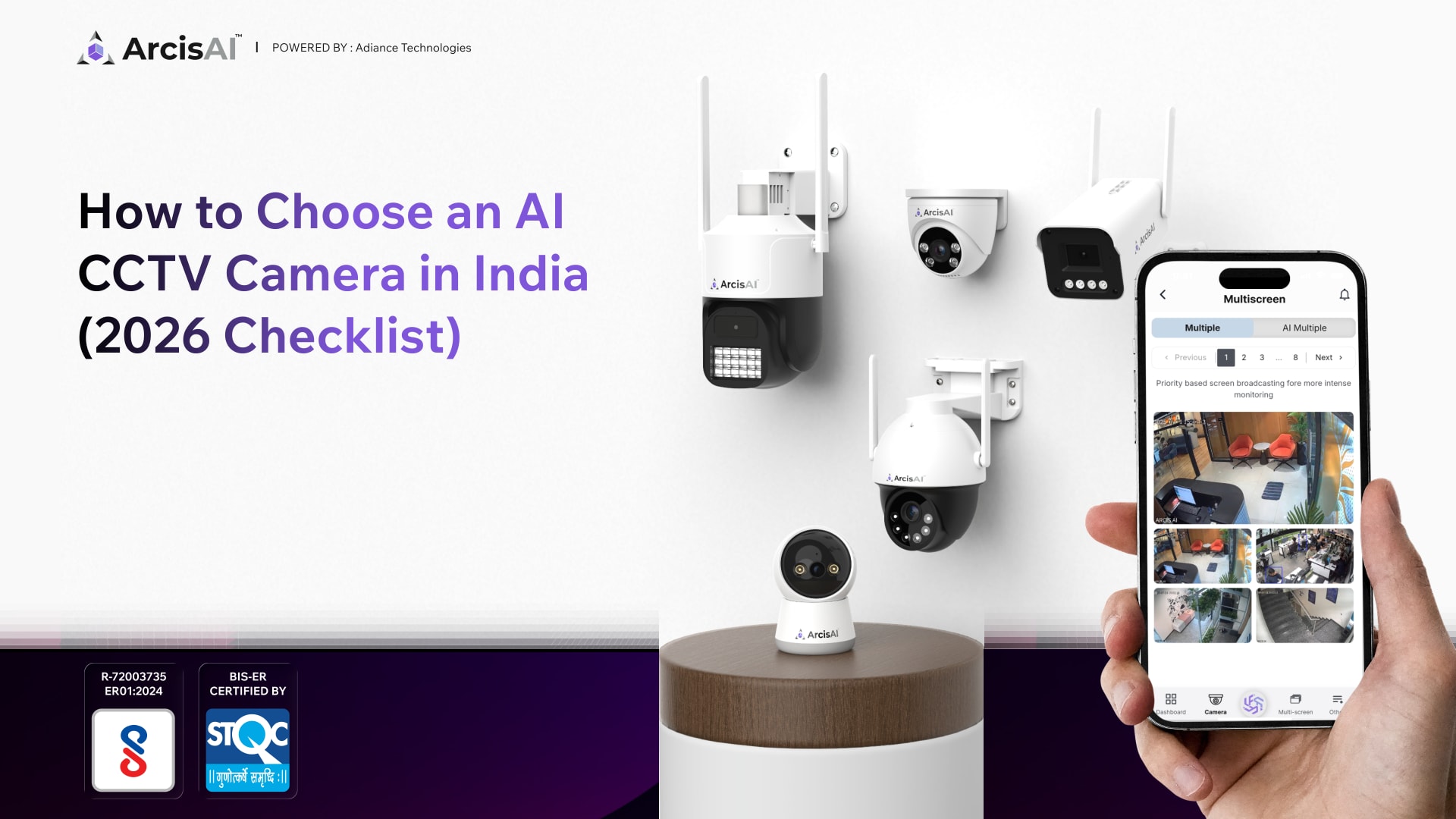
Quick answer: Choosing the best AI CCTV camera in India means matching resolution (3–8 MP), camera form factor, connectivity (PoE/WiFi/4G), edge or cloud AI capability, BIS-ER certified hardware, and STQC-certified VMS software to your site's specific needs — then verifying service coverage and total cost of ownership before you commit.
Table of Contents
Why Does Choosing the Right AI CCTV Camera Matter?
What Certifications Should You Look For?
What Resolution Do You Actually Need?
Which Camera Type Is Right for Your Location?
What Connectivity Option Should You Choose: PoE, WiFi, or 4G?
What Is the Difference Between Edge AI and Cloud AI?
Does Night Vision Technology Matter?
What Weatherproofing Rating Do You Need?
How Should You Think About Storage?
What Should You Evaluate in the VMS and Mobile App?
Is Scalability and Multi-Site Management Important?
What About Service, Warranty, and Support?
Does Made-in-India or NDAA Compliance Matter for Your Use Case?
What Is Total Cost of Ownership (TCO)?
The 10-Point AI CCTV Buying Checklist
Where Does ArcisAI Fit?
Why Does Choosing the Right AI CCTV Camera Matter?
India's surveillance market is growing fast, and so is the number of cameras claiming "AI" capability. Not every product delivers meaningful intelligence, reliable uptime, or compliance with Indian standards. A wrong purchase means wasted capital, recurring false alarms, and security gaps. This guide cuts through the noise with a practical, step-by-step framework any buyer can use — from a single shop to a multi-site enterprise.
What Certifications Should You Look For?
Certification is the single most important filter before you evaluate any other spec.
BIS-ER Certification for Hardware
The Bureau of Indian Standards Electronics and IT Goods (Mandatory Registration) Order requires surveillance cameras sold in India to carry a BIS-ER mark. This confirms the hardware meets Indian safety and electromagnetic compatibility standards and is manufactured or tested under a registered process. When evaluating a camera, ask the vendor for their BIS Registration Number and verify it on crsbis.in.
STQC Certification for VMS Software
This is the certification most buyers overlook — and it matters most for WiFi-connected and cloud-capable cameras. The Standardisation Testing and Quality Certification (STQC) Directorate under MeitY certifies Video Management Software (VMS) for security, reliability, and data-handling standards. A camera's hardware may be BIS-ER certified, but if the VMS or mobile app transmitting your video has not been STQC certified, your data security and compliance posture is unverified. Always ask for STQC certification on the VMS, not just the camera body. Verify on stqc.gov.in.
What Resolution Do You Actually Need?
Higher resolution is not always better — it comes at a cost in storage, bandwidth, and processing. Use this as a baseline:
Resolution — Pixels — Best For
3 MP — ~2048 × 1536 — General monitoring, corridors, small retail
5 MP — ~2592 × 1944 — Parking lots, mid-size offices, warehouses
8 MP (4K) — ~3840 × 2160 — Entry points, license plate reading, large open areas
For most Indian SME sites, 5 MP strikes the right balance between image clarity and storage economy. If you need to read number plates or identify individuals at distance, consider 8 MP at critical points and 3–5 MP elsewhere.
Which Camera Type Is Right for Your Location?
Camera form factor is a physical and functional decision. The table below maps each type to its ideal deployment scenario.
Camera Type — Typical Coverage — Best Use Cases — Key Limitation
Bullet — Narrow, long-distance — Perimeter, parking lanes, entry gates — Fixed angle; visible deterrent
Dome — Wide, 180° — Retail floors, lobbies, ceilings — Shorter range than bullet
PTZ — 360° pan/tilt/optical zoom — Large open spaces, stadiums, campuses — Higher cost; moving parts
Mini-PTZ — Compact 360°/zoom — Meeting rooms, mid-size retail, restaurants — Lower zoom range than full PTZ
Covert/Cube — Discreet — Offices, reception desks — Not for outdoor or wide-area
A layered approach — bullet cameras on perimeter walls, domes on ceilings indoors, one PTZ per large open zone — typically gives the best coverage-to-cost ratio.
What Connectivity Option Should You Choose: PoE, WiFi, or 4G?
Power over Ethernet (PoE) is the most reliable choice for permanent installations. A single Cat-6 cable carries both power and data, eliminating separate power cabling and reducing failure points. PoE cameras are recommended for warehouses, manufacturing plants, and any site where cabling is feasible.
WiFi cameras are faster to deploy and cost-effective for small retail or rented premises. Their trade-off: susceptibility to interference, network congestion, and the added importance of a STQC-certified VMS (since all video travels over your wireless network).
4G/LTE cameras suit remote sites — construction zones, agricultural land, or highway installations — where wired and WiFi infrastructure is absent. Factor in recurring SIM/data costs in your TCO calculation.
What Is the Difference Between Edge AI and Cloud AI?
This distinction determines where the intelligence lives and directly affects latency, bandwidth, privacy, and scalability.
Edge AI (On-Camera Processing)
Edge AI cameras embed an AI chip (typically an NPU or DSP) directly in the camera. Detections — such as person, vehicle, intrusion, loitering, crowd density, or face recognition — happen on the device itself, in milliseconds, without sending raw video to a server.
Advantages: Low latency, works during network outages, preserves bandwidth, keeps raw video local (strong for privacy-sensitive sites).
Best for: Retail stores, banks, residential complexes, sites with limited bandwidth.
Cloud AI (Server-Side Analytics)
Cloud AI sends video streams to a central server or cloud platform, where more powerful computing runs analytics — typically at larger scale, across many cameras simultaneously.
Advantages: Unlimited processing power, scalable to hundreds of cameras, enables cross-camera correlation and city-scale analytics.
Best for: Large enterprises, smart city deployments, multi-site operators who need aggregated insights.
Hybrid approach: Many modern deployments use edge AI for real-time on-site alerts and cloud AI for retrospective analytics, reporting, and multi-site dashboards — giving you the best of both.
Does Night Vision Technology Matter?
Yes. Two technologies dominate:
Infrared (IR) Night Vision illuminates the scene invisibly and renders video in black and white. It works at long ranges (up to 50–80 m on quality cameras) and consumes less power. Suitable for perimeters and parking areas.
Color Night Vision (Full-Color) uses a large image sensor and supplemental white-light LEDs to produce color images in low light. Color footage makes identification — clothing color, vehicle color — significantly easier. Better for entrances and indoor areas where color detail aids incident review.
For critical entry points, color night vision is worth the modest premium.
What Weatherproofing Rating Do You Need?
IP66 — Dust-tight and protected against powerful water jets. Suitable for most Indian outdoor environments including monsoon conditions.
IP67 — Dust-tight and can withstand temporary immersion up to 1 m. Required for flood-prone ground-level installations or industrial wash-down environments.
For rooftop and outdoor perimeter cameras in India, IP66 is the minimum acceptable standard.
How Should You Think About Storage?
Storage strategy has a direct impact on ongoing costs and footage accessibility.
• SD Card (on-camera): Lowest cost, good for single-camera or small sites. Vulnerable to tampering if the camera is physically accessible.
• NVR (Network Video Recorder): Centralized, secure on-premises storage. Recommended for 4+ cameras. Choose NVRs with RAID or redundancy for critical sites.
• Cloud Storage: Enables remote access and off-site backup. Factor in ongoing subscription cost. Ensure your cloud provider and VMS are compliant with Indian data residency requirements.
A practical rule: retain 15–30 days of footage for most commercial sites, and 60–90 days for finance, healthcare, or government sites.
What Should You Evaluate in the VMS and Mobile App?
The VMS (Video Management Software) is the brain of your camera system. Evaluate it as rigorously as the camera hardware:
• Live view and multi-camera grid: Can operators monitor all cameras from one screen?
• Search and playback: Can you search footage by event type (motion, intrusion, face) rather than scrubbing through hours of video?
• Alert management: Are AI alerts actionable and configurable? Can you set schedules and sensitivity zones?
• Mobile app: Does it support live view, playback, and push notifications on both Android and iOS?
• STQC Certification: As noted above, this is the quality and security benchmark for VMS software sold in India.
Is Scalability and Multi-Site Management Important?
If you operate more than one site — or plan to grow — choose a platform that supports multi-site management from a single dashboard. This means centralized health monitoring, unified alert feeds, consolidated reporting, and role-based access so branch managers see only their own cameras. Buying a single-site-only system and expanding later often results in fragmented infrastructure and higher long-term cost.
What About Service, Warranty, and Support?
Hardware quality is irrelevant if support is unavailable. Before purchasing, confirm:
• Warranty period: Minimum 1 year; 3 years is better for infrastructure cameras.
• On-site service coverage: Does the vendor or their partner have engineers in your city or district?
• SLA for camera replacement or repair: 24–48 hours is a reasonable benchmark for commercial installations.
• Firmware update policy: AI cameras should receive regular firmware and model updates to stay effective.
Does Made-in-India or NDAA Compliance Matter for Your Use Case?
For government tenders and PSU projects, Made-in-India cameras manufactured under MEITY/MHA guidelines or PLI schemes receive preference in procurement. Always verify with your specific tender requirements.
For export projects or any deployment involving US government-funded infrastructure, cameras must be NDAA (National Defense Authorization Act) compliant — meaning they cannot contain components from certain restricted manufacturers. NDAA compliance is increasingly requested in enterprise and hospitality procurement as well, even outside government contexts.
What Is Total Cost of Ownership (TCO)?
The purchase price of a camera is typically 40–60% of its true 3-year cost. Factor in:
Cost Component — Notes
Camera hardware — One-time
NVR / storage — One-time + expansion
Cabling & installation — One-time
VMS license — Annual or per-camera
Cloud storage subscription — Monthly/annual
4G/SIM data costs — Monthly (if applicable)
Maintenance & support — Annual contract
Firmware/AI model updates — Included or paid?
Always ask vendors for a 3-year TCO estimate, not just the hardware sticker price.
The 10-Point AI CCTV Buying Checklist
Use this before signing any purchase order:
1. BIS-ER hardware certification confirmed — verify the registration number on crsbis.in
2. STQC-certified VMS software confirmed — verify on stqc.gov.in (critical for WiFi/cloud cameras)
3. Resolution matched to use case — 3 MP / 5 MP / 8 MP selected per camera location
4. Camera type selected per zone — bullet/dome/PTZ/mini-PTZ mapped to site plan
5. Connectivity method chosen — PoE for permanent, WiFi for flexible, 4G for remote
6. Edge AI or cloud AI capability confirmed — and deployment model chosen
7. Night vision type selected — IR for perimeter/distance, color for entry/ID purposes
8. IP66 or IP67 weatherproofing confirmed for all outdoor cameras
9. Storage plan and retention period defined — SD / NVR / cloud / hybrid
10. Service SLA, warranty, and multi-site scalability confirmed with vendor in writing
Where Does ArcisAI Fit?
For buyers who want a single vendor covering all the boxes above, ArcisAI (arcisai.io) — by Adiance Technologies, founded in 2003 — is a strong Indian option worth evaluating:
• BIS-ER certified hardware: Registration No. R-72003735 under ER01:2024 (verify on crsbis.in)
• STQC-certified VMS: Software certified by STQC Directorate, MeitY
• Edge AI: Eight on-camera detections including intrusion, loitering, crowd density, and more — processing on the device, not the cloud
• ArcisGPT: A conversational AI interface that lets operators query camera footage in natural language
• Bridge Device: A retrofit solution that adds AI intelligence to existing non-AI cameras, protecting legacy infrastructure investment
• Made in India and NDAA compliant: Suitable for government tenders, PSU deployments, and export projects
• Enterprise scalability: Multi-site management for large and distributed deployments
ArcisAI is one strong option among several in the market. The checklist above applies regardless of which vendor you choose.
Frequently Asked Questions
Table of Contents
Why Does Choosing the Right AI CCTV Camera Matter?
What Certifications Should You Look For?
What Resolution Do You Actually Need?
Which Camera Type Is Right for Your Location?
What Connectivity Option Should You Choose: PoE, WiFi, or 4G?
What Is the Difference Between Edge AI and Cloud AI?
Does Night Vision Technology Matter?
What Weatherproofing Rating Do You Need?
How Should You Think About Storage?
What Should You Evaluate in the VMS and Mobile App?
Is Scalability and Multi-Site Management Important?
What About Service, Warranty, and Support?
Does Made-in-India or NDAA Compliance Matter for Your Use Case?
What Is Total Cost of Ownership (TCO)?
The 10-Point AI CCTV Buying Checklist
Where Does ArcisAI Fit?
Send Us a Message