Color Night Vision CCTV Camera: See Colour, Faces and Number Plates Clearly, Even After Dark
Kushal Sanghvi
Published●June 23, 2026
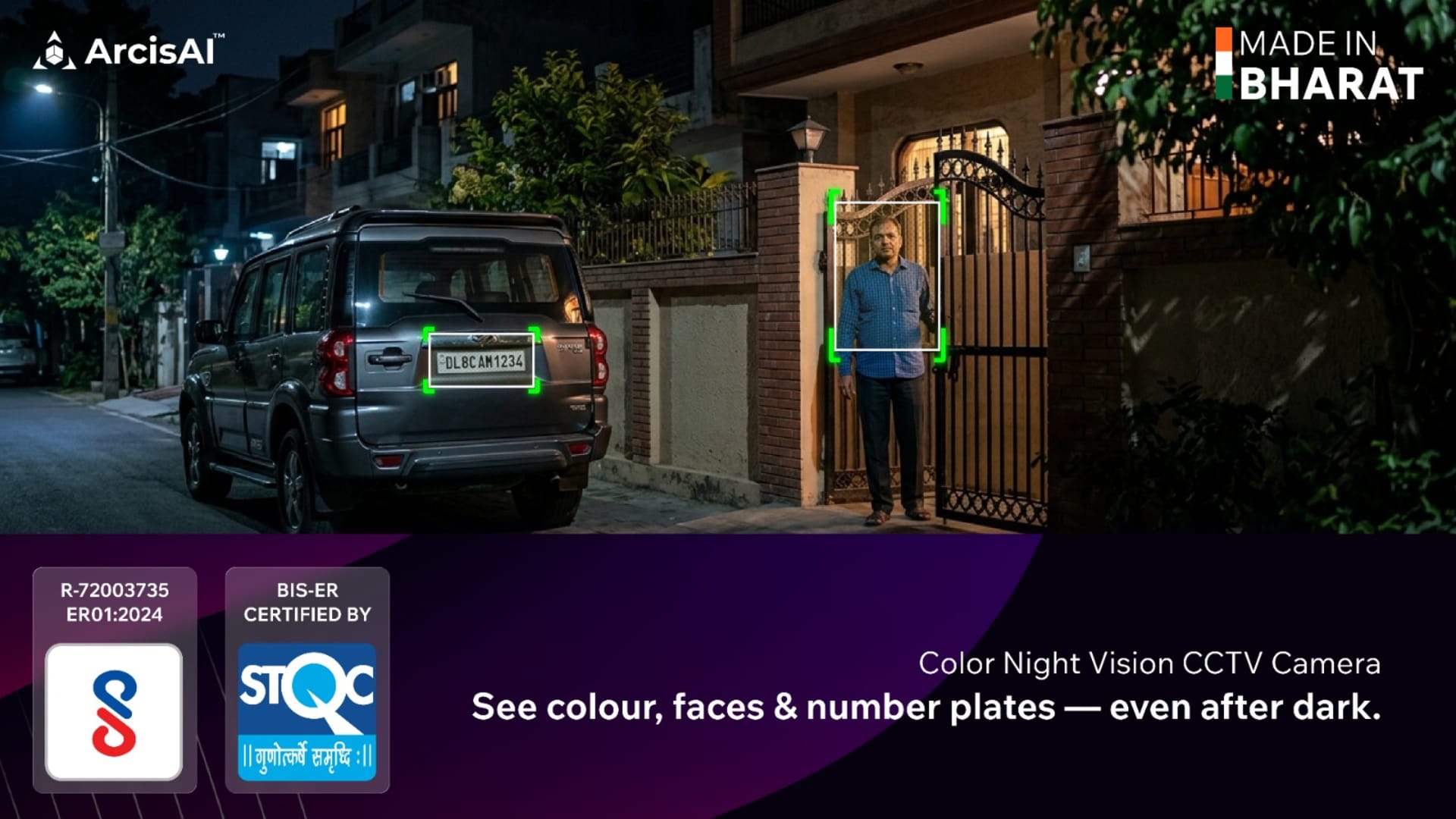
Most CCTV cameras go half-blind the moment the sun sets. The footage still records. It just stops being useful.
You have probably seen it. A grey, grainy clip where a person is clearly there, but you cannot tell the colour of their shirt, the bag they carried, or the car they drove off in. The camera saw something. It did not see anything you can actually use.
For years that was accepted as simply how "night mode" works. It does not have to be. The gap between footage you can act on and footage you just file away usually comes down to one thing: whether your camera can hold colour and detail after dark. This guide explains what a color night vision CCTV camera really is, why the old infrared trade-off costs you the details that matter, and what to check before you buy so your night footage is a lead instead of a smudge.
Why Most Night Footage Is Grey and Useless
Traditional night vision relies on infrared. The camera floods the scene with IR light your eyes cannot see, then records the result in black and white.
That approach has one real strength. IR is invisible, so the camera does not announce that it is watching, and it works even in total darkness. The problem is what you lose. At night, colour is often the only detail that matters. "Tall man in a dark jacket" describes half the street. "Tall man in a red jacket" is an actual lead. Strip the colour out and you strip out the part of the footage an investigation, an insurer, or a court can use.
To fix that, some cameras swung the other way and ran a bright white light all night for full colour. It works, but a spotlight blazing until dawn annoys neighbours, wastes power, and throws away the discreet advantage of a camera nobody notices.
So buyers were left choosing between two compromises. Discreet but colourless, or colourful but glaring. Neither is the right answer, because the right answer is not one fixed mode at all.
What "Color Night Vision" Actually Means
Color night vision is the camera's ability to keep producing usable colour images in low light instead of dropping to black and white. There are two common ways a camera does this.
The first is a supplementary white light, sometimes called dual-light or warm-light technology, that switches on so the sensor can record colour. The second is a high-sensitivity, low-light sensor, often marketed as starlight technology, that pulls in the small amount of ambient light already present, from street lamps, signage, or the moon, and renders it in colour rather than grey.
The best cameras combine both and let the situation decide which to use. That is the shift worth understanding before you compare models, because a camera that locks you into a single way of seeing will always disappoint you at the worst moment.
One Camera, Several Viewing Modes
A capable color night vision CCTV camera should not force a single setting on you. It should offer a set of viewing modes so you can match the camera to the site. The better systems run several, and each has a clear job.
IR mode uses built-in infrared LEDs to light the scene with light the eye cannot see. Footage is black and white, but the camera stays completely invisible. Best when you simply want a quiet, clean overnight record.
Light mode keeps bright white LEDs on like a small floodlight, giving full colour all night. Good for a shop entrance or a till point where you always want maximum detail.
Smart mode is the hybrid most sites should run. The camera sits in discreet black-and-white IR by default. The instant it detects a person or vehicle, it switches on the white light and flips to colour, then settles back down once the scene is clear. Quiet when nothing is happening, full colour the second something does.
Daylight mode is for the day. An IR-cut filter blocks infrared so it cannot wash out or discolour the image, leaving crisp, true full-colour footage.
Night mode is a low-light setting that pulls in every bit of available light using starlight-style sensitivity, so even a dim scene comes through in colour rather than grey.
The principle is simple. With real modes you match the camera to the moment instead of fighting its limits.
Why This Matters More Than the Spec Sheet Suggests
Think about what you actually do with footage. You almost never watch it live at 2am. You pull it up after something has already gone wrong.
In that moment, the difference between grey and colour is the difference between a clip you can act on and a clip you just archive. A delivery dispute. A car clipped in a housing society car park. A figure near a warehouse fence. In every case the useful version of the footage is the one that captured a colour, a face, or a number plate clearly enough to matter.
Night is exactly when most of these incidents happen. It is the worst possible time for your cameras to be at their weakest, and it is the reason colour performance after dark deserves more weight in your buying decision than it usually gets.
How to Read a Night Vision Claim Before You Buy
Not every camera labelled "color night vision" performs the same once it is mounted. A few checks before purchase save most of the disappointment.
Start with the question of how the camera achieves colour at night, whether through a supplementary white light, a low-light sensor, or both, and whether you can choose between them. A camera with only one mode will not suit every position on your site. Next, look at the effective range, not just whether it "sees in the dark" but how far it holds usable detail, since a claim with no distance attached tells you very little.
Then consider whether the white light can be triggered intelligently rather than left blazing all night, which is what a smart hybrid mode gives you. Finally, for any site that touches government or institutional procurement, confirm the certifications. A genuinely STQC certified and BIS-ER certified camera that is NDAA compliant clears compliance hurdles that a cheaper grey-market unit never will, and that matters as much as the picture quality on a tender-funded project.
Run through those points and you will know whether a camera will hand you a lead or a smudge at the moment you need it most.
A Camera Built to Tick Every Box
Put that checklist together and the requirement is clear: a camera that records real colour at night, holds detail at a useful range, switches modes intelligently, and carries the certifications a serious project needs. That is the gap the ArcisAI range, from Indian manufacturer Adiance Technologies, was built to fill.
Rather than locking you into one compromise, ArcisAI cameras run all five viewing modes covered above. The same camera can stay invisible overnight on IR, capture full colour the instant a person or vehicle appears, and switch to a crisp true-colour picture by day. On the 3MP range, night vision holds out to 20 metres, enough to cover the gate, yard, shopfront, or corridor most sites actually need to be watched, so the figure at your fence comes through sharp rather than as a blur.
The certifications are handled too. ArcisAI is a BIS-ER certified and STQC certified CCTV brand, NDAA compliant, and made in India with no high-risk foreign components. For government tenders, GeM procurement, and PSU projects, those are not optional extras, they are the entry ticket, which makes a certified camera the safe default rather than a premium upgrade.
The Takeaway
Night vision should not mean settling for footage you cannot use. The point of real viewing modes is straightforward: stay invisible when nothing is happening, capture everything in colour the moment it does, and give the day its own crisp setting too.
If your current cameras still hand you grey, guessy clips every morning, that is not a limitation of night. It is a limitation of the camera. A certified color night vision CCTV camera fixes the part you can actually control.
Want footage you can actually act on, even in dark? Book a free demo.
Book a Demo