Bullet vs Dome vs PTZ: Which CCTV Form Factor for Each Spot
Kushal Sanghvi
Updated●July 14, 2026
Most CCTV mistakes are not made at the recorder or in the software. They are made at the moment someone picks the shape of the camera. A buyer orders whatever looks familiar, or whatever the quote lists first, and only later notices the gaps: a driveway that turns to a blur at night, a shop floor with a corner nobody can see, a parking lot where one camera keeps looking the wrong way.
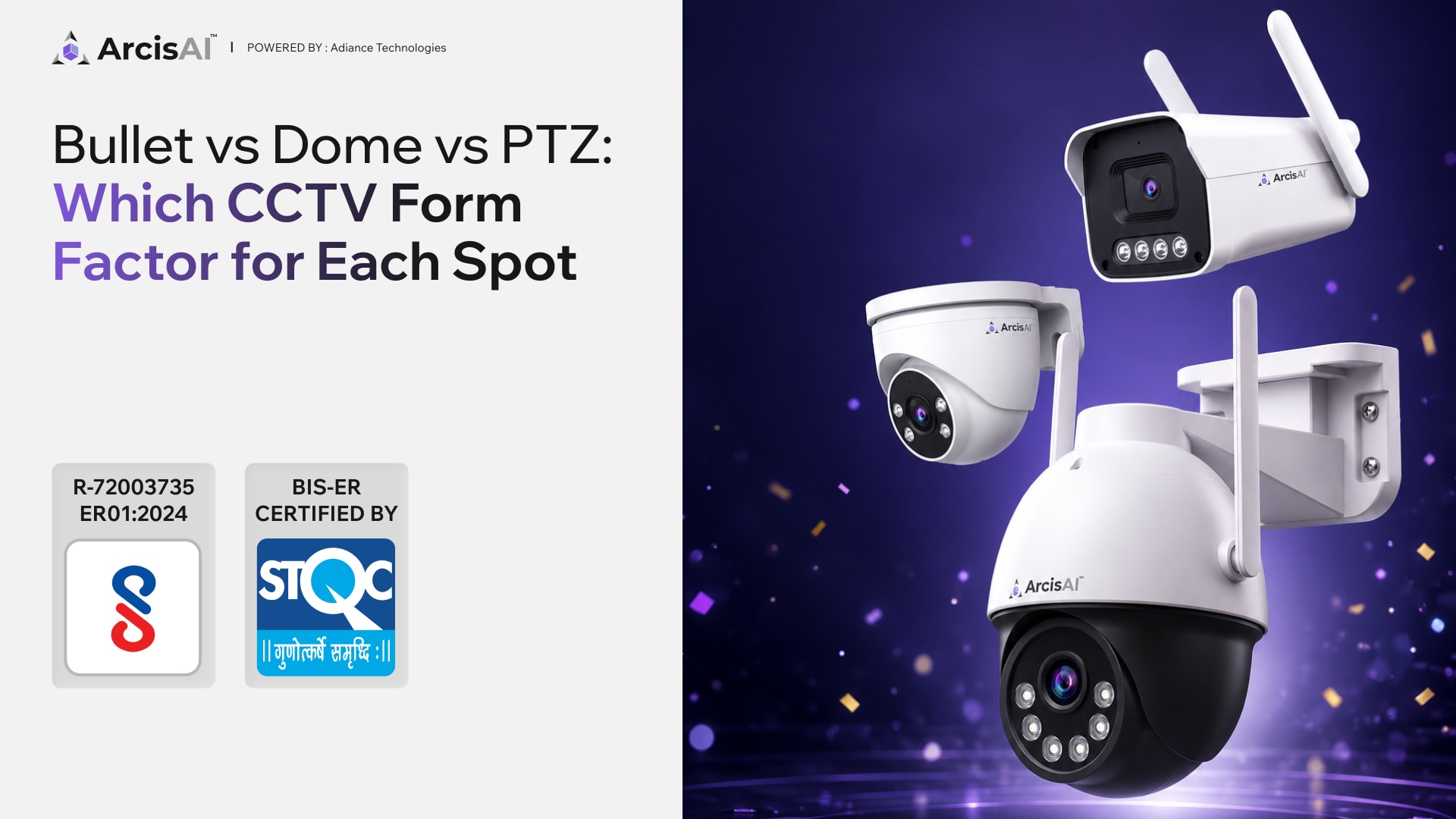
The shape of a camera is not styling. Bullet, dome, and PTZ each see the world differently, and each is built for a different kind of spot. Put the wrong one in the wrong place, and no amount of resolution will fix the blind spot it creates.
Here is the short version before the detail. Bullet cameras are for long, straight lines of sight and visible deterrence. Dome cameras are for discreet, wide coverage indoors and in public areas. PTZ cameras are for large open spaces you actively watch. The rest of this guide shows how to match each one to the exact spot it belongs in.
Table of Contents
Why Form Factor Decides Coverage, Not Just Looks
Bullet Cameras: Long Range and Visible Deterrence
Dome Cameras: Discreet, Wide, and Hard to Tamper
PTZ Cameras: One Camera That Covers a Lot, When Watched
Which Camera for Each Spot
The Mistake That Creates Blind Spots
Matching Form Factor to a Certified, Made-in-India Range
Why Form Factor Decides Coverage, Not Just Looks
Why Form Factor Decides Coverage, Not Just Looks
Every camera trades off reach, field of view, discretion, and control. A shape that is perfect over a warehouse floor is wasted in a narrow corridor, and a camera that is ideal at a reception desk is useless watching a boundary wall two hundred feet away.
So the useful question is never "which is the best CCTV camera type." It is "which type fits this spot." Get that right at each location, and the system covers everything with fewer cameras. Get it wrong, and you buy more cameras to patch holes you created yourself.
Bullet Cameras: Long Range and Visible Deterrence
Bullet Cameras: Long Range and Visible Deterrence
A bullet camera is the long cylinder mounted under an eave or on a wall, pointing in one fixed direction. Its shape gives it room for a bigger lens, so it reaches further than most domes and holds detail at a distance.
Bullet cameras are the right call when you need long, straight coverage such as driveways, boundary walls, corridors, and approach roads. They also give obvious presence: a visible camera is a deterrent in itself, which is why bullets suit entrances and perimeters. And they hold up outdoors, with a built-in sunshade that helps with glare and rain, and weatherproof housings as standard.
The watch-outs are simple. A bullet only covers the one direction it is aimed at, so it is a poor choice for a room that needs eyes everywhere. Mount it within arm's reach and it can be knocked out of position, so keep it high or protected.
Dome Cameras: Discreet, Wide, and Hard to Tamper
Dome Cameras: Discreet, Wide, and Hard to Tamper
A dome camera sits in a low, rounded housing on a ceiling or wall. The tinted dome hides which way the lens is pointing, and the smooth shape gives a would-be vandal nothing to grab. In the dome vs bullet camera decision, this is what tips it: discretion and tamper resistance over raw reach.
Dome cameras earn their place indoors, on retail floors, in offices, lobbies, clinics, and hospitality spaces, where wide coverage matters more than distance. Their low profile blends into a ceiling instead of dominating the room, and in public or high-traffic areas, IK-rated domes shrug off knocks and tampering that would put a bullet camera out of action.
Their limit is range. A standard dome is built for rooms and entryways, not for watching the far end of a yard. For long outdoor distances, a bullet or PTZ usually does the job better.
PTZ Cameras: One Camera That Covers a Lot, When Watched
PTZ Cameras: One Camera That Covers a Lot, When Watched
PTZ stands for pan, tilt, and zoom. A PTZ camera moves on motors and carries a powerful optical zoom, so it can sweep a wide area and then push in for a face or a number plate far away. One PTZ can watch ground that would otherwise need several fixed cameras.
PTZ camera uses cluster around large, open, actively monitored spaces: parking lots, campuses, stadiums, ports, and industrial yards. They suit live monitoring, where an operator, or auto-tracking, follows a subject as it moves, and they deliver detail on demand, pulling a clear image from a distance no fixed camera would manage.
Not every site needs a full-size PTZ, though. For smaller open areas, such as a compact yard, a single-entry parking stretch, or a courtyard, a Baby PTZ gives the same pan-tilt-zoom flexibility in a smaller, more affordable unit, without asking you to install enterprise-grade hardware to cover a modest space.
There is one catch that decides everything, whichever size you choose. A PTZ only sees where it is pointing at that moment. Turn it toward the east gate, and it is blind to the west one. That is why a PTZ should almost never be the only camera covering a space.
Which Camera for Each Spot
Which Camera for Each Spot
Match the form factor to the location, and the choices become obvious.
For perimeters, boundaries, and long driveways, use bullet cameras for the reach and the visible deterrent. Add a PTZ, or a Baby PTZ on a smaller site, if the area is large and someone is watching it. For entrances and doorways, a bullet works well outdoors at a distance, while up close and indoors, a dome gives cleaner, less obtrusive coverage.
Indoor retail, offices, lobbies, and hospitality spaces call for domes, which win on wide angles, a low profile, and tamper resistance. Large open areas like parking lots and yards do best led by a PTZ for active coverage, backed by fixed cameras so nothing goes unrecorded when the PTZ turns away; a compact site can get the same effect from a Baby PTZ. High-risk and public spaces such as schools, transit stations, and corridors call for vandal-resistant, IK-rated domes that survive knocks and interference. Warehouses and factories usually need a mix: bullets down the aisles for fixed lines of sight, a PTZ over the open floor for flexible reach.
The Mistake That Creates Blind Spots
The Mistake That Creates Blind Spots
The most common and most expensive error is trusting a single PTZ to cover a whole site. It looks efficient on paper. In practice, the moment it swings one way, everything behind it is unrecorded, and a determined intruder learns the pattern quickly.
The fix is to think in layers. Fixed cameras, bullets and domes, give continuous coverage that never looks away. A PTZ, full-size or Baby, sits on top of that layer for reach and detail. Used together, they cover far more than either does alone. The same logic applies to mounting height and connectivity: keep cameras out of reach, and match the wiring, whether WiFi, PoE, or 4G, to what the spot allows before you buy.
Matching Form Factor to a Certified, Made-in-India Range
Matching Form Factor to a Certified, Made-in-India Range
Once you know which shape belongs where, the practical need is a single range that offers all three without forcing a compromise on quality or compliance.
That is where the ArcisAI Eco-Series, from Indian manufacturer Adiance Technologies, is built to fit. The range covers bullet, dome, and PTZ options, including the compact Baby PTZ, across resolutions, so you can build each spot correctly rather than settling for what is in stock, with WiFi, PoE, and 4G options so the camera you choose matches how each location is wired.
The Eco-Series is also BIS-ER certified and STQC certified, made in India with no Chinese components, which matters for tenders, government procurement, and any site where long-term support and origin are non-negotiable.
Pick the right shape for each spot, from a certified, made-in-India range built for these conditions, and you cover the whole site with fewer cameras and no surprises.
Frequently Asked Questions
Table of Contents
Why Form Factor Decides Coverage, Not Just Looks
Bullet Cameras: Long Range and Visible Deterrence
Dome Cameras: Discreet, Wide, and Hard to Tamper
PTZ Cameras: One Camera That Covers a Lot, When Watched
Which Camera for Each Spot
The Mistake That Creates Blind Spots
Matching Form Factor to a Certified, Made-in-India Range
Send Us a Message