ArcisAI vs Hikvision: AI CCTV Camera Comparison for India 2026 | Features, Certification, Edge AI
Kushal Sanghvi
Published●March 4, 2026
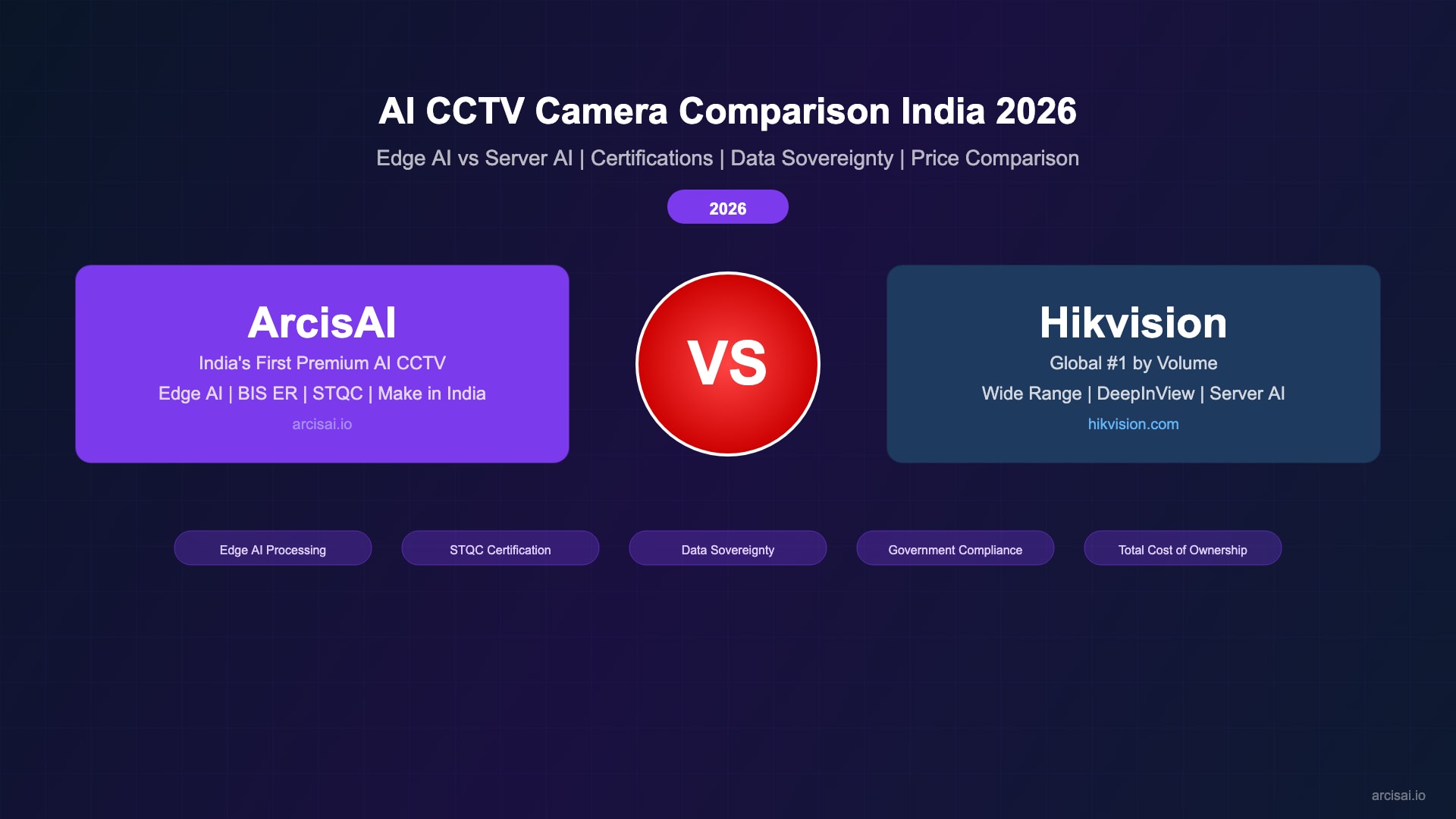
Comprehensive comparison of ArcisAI and Hikvision AI CCTV cameras for the Indian market in 2026. We compare edge AI vs server-based AI processing, certifications (STQC, BIS ER, Make in India), data sovereignty implications, government compliance, pricing, and total cost of ownership to help buyers make an informed decision.
Why Compare ArcisAI and Hikvision?
Why Compare ArcisAI and Hikvision?
Hikvision is the world's largest CCTV manufacturer by volume, with a massive global footprint and a wide product range covering everything from budget cameras to enterprise-grade AI solutions. ArcisAI, on the other hand, is India's first premium AI CCTV brand — built from the ground up around edge AI processing with full Indian government certifications. These two brands represent fundamentally different approaches to AI surveillance: Hikvision's server-centric AI architecture versus ArcisAI's edge-first design. For Indian buyers — especially those in government, enterprise, and critical infrastructure — this comparison matters because the choice affects not just camera performance, but also data sovereignty compliance, total cost of ownership, and long-term scalability. Both brands bring real strengths, and the right choice depends on your specific requirements.
Edge AI vs Server-Based AI: The Core Architecture Difference
Edge AI vs Server-Based AI: The Core Architecture Difference
This is the most significant technical difference between the two brands. ArcisAI builds every camera with an on-device neural processing unit (NPU) — face recognition, ANPR, intrusion detection, people counting, and object tracking all happen directly on the camera chip in real-time. No external server required. Hikvision offers edge AI in some premium models (DeepinView series), but their broader product line relies on server-based analytics — cameras capture video and send it to dedicated GPU servers (like their DeepinMind NVRs) for AI processing. The practical implications are significant: ArcisAI's edge approach means AI works even if the network drops, bandwidth requirements are dramatically lower (only metadata is sent to the cloud, not full video streams), and there's no single point of failure. With server-based AI, if the analytics server goes down, you lose all AI capabilities across every camera connected to it. For large deployments (50+ cameras), the infrastructure cost difference is substantial — edge AI eliminates the need for ₹5-15 lakh GPU servers entirely.
Certifications and Government Compliance
Certifications and Government Compliance
For Indian government projects and critical infrastructure, certifications determine whether your bid even gets considered. ArcisAI's Eco Series cameras hold BIS ER certification, while their VMS and mobile app software are STQC certified by MeitY. All products are manufactured in India under the Make in India initiative. This combination — BIS ER + STQC + Make in India — makes ArcisAI compliant with most government procurement requirements. Hikvision, being a Chinese-origin company (subsidiary of CETC, a Chinese state-owned enterprise), faces increasing procurement restrictions in India. Several government tenders now explicitly require Make in India certification or restrict Chinese-origin surveillance equipment, particularly for sensitive installations. Hikvision does not hold STQC certification for the Indian market. For private enterprise buyers, Hikvision's certifications (CE, FCC, UL) are globally recognized and adequate. But for government, defense, banking, and critical infrastructure projects in India, ArcisAI's certification portfolio provides a clear compliance advantage.
Data Sovereignty and Cybersecurity
Data Sovereignty and Cybersecurity
Data sovereignty has become a major factor in CCTV procurement decisions globally, and India is no exception. ArcisAI's cloud platform is hosted on Indian servers with data residency guarantees. Their VMS software is developed in-house in India, and the entire technology stack — from camera firmware to cloud AI — is controlled domestically. Hikvision's products have faced cybersecurity scrutiny in multiple countries. The US government banned Hikvision equipment from federal installations (NDAA Section 889), and several European countries have issued advisories about Chinese-origin surveillance equipment. While Hikvision has invested in cybersecurity improvements and maintains that their products are secure, the origin-of-control question remains a consideration for security-sensitive deployments. For buyers in banking (RBI-regulated), government, defense, or any sector handling sensitive data, ArcisAI's fully Indian technology stack provides stronger data sovereignty assurance. For commercial and retail deployments where data sensitivity is lower, this factor may be less critical.
Product Range, Pricing, and Total Cost of Ownership
Product Range, Pricing, and Total Cost of Ownership
Hikvision's biggest advantage is product breadth and pricing. They offer everything from ₹1,500 budget cameras to ₹50,000+ enterprise models, with the largest dealer network in India. Their economies of scale mean aggressive pricing, especially in the budget and mid-range segments. ArcisAI positions itself in the premium segment (₹8,000+) but argues that total cost of ownership (TCO) is actually lower for AI deployments. Since every ArcisAI camera has built-in edge AI, you don't need separate analytics servers. A 100-camera ArcisAI deployment with full AI analytics might cost less overall than 100 budget Hikvision cameras plus GPU analytics servers plus annual software licenses. ArcisAI offers WiFi PTZ, WiFi Dome, IP Dome, IP Bullet, 4G Bullet, and 5G PTZ camera variants — covering most enterprise use cases. They also offer the Arcis Bridging Device (ABD) that adds edge AI capabilities to existing non-AI cameras, allowing organizations to upgrade gradually. Hikvision's range is broader, particularly at the low end. If you need basic recording without AI, Hikvision offers more budget options. But if you need AI analytics across your deployment, calculate TCO carefully — the camera-plus-server model often costs more than edge AI cameras alone. Both brands bring genuine strengths to different segments of the market, and the right choice depends on your specific requirements around compliance, AI needs, budget constraints, and data sensitivity.