ANPR Cameras in India: Number Plate Recognition for Security & Access (2026)
Kushal Sanghvi
Updated●June 4, 2026
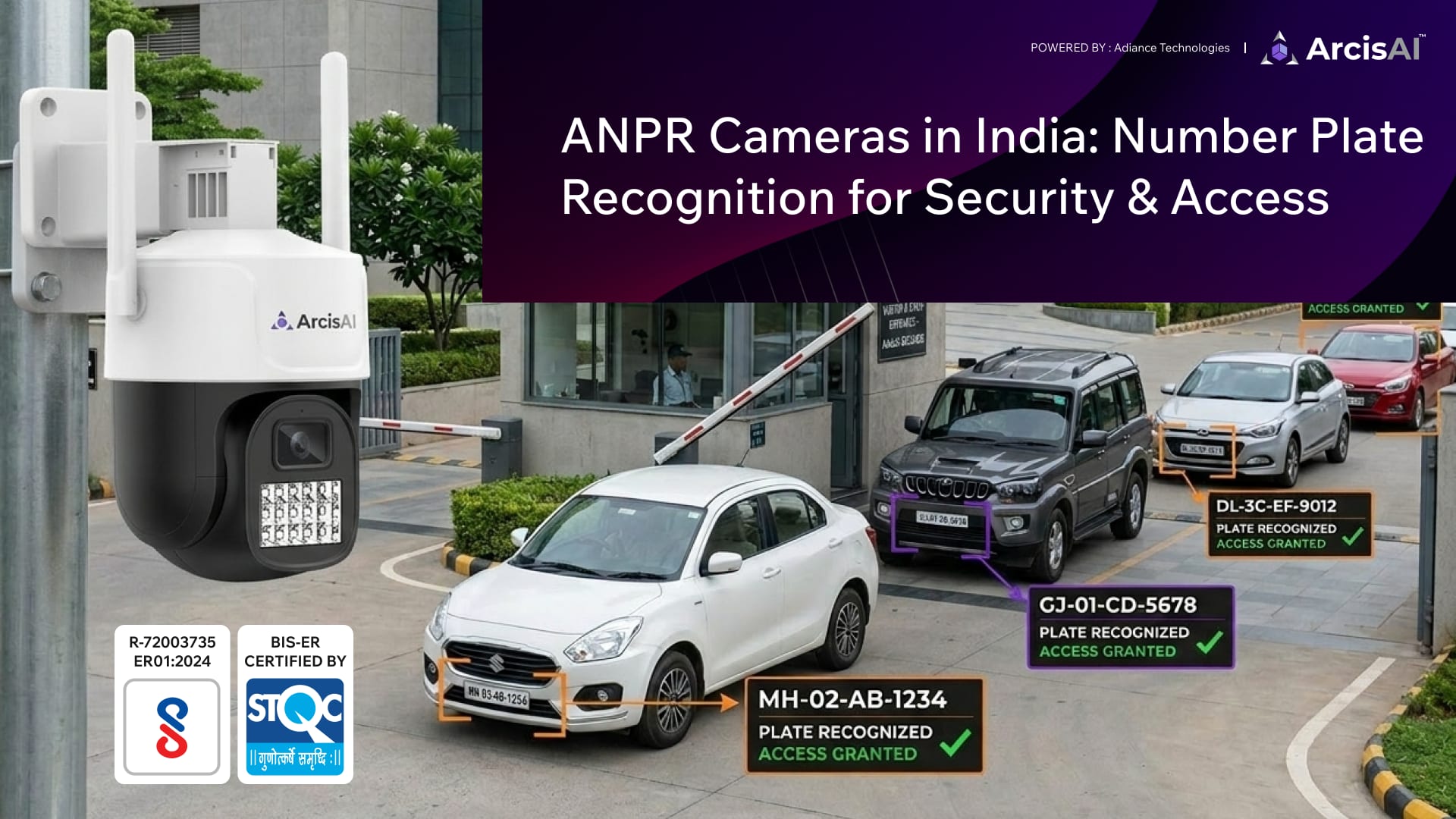
An ANPR camera in India uses AI to read a vehicle's number plate in real time, match it against a registered database, and trigger automated entry or an alert — all in under two seconds. Deployed at society gates, parking facilities, warehouses, and toll plazas, it replaces manual vehicle logging with an accurate, timestamped digital record that security teams and managers can search instantly.
Table of Contents
What Is an ANPR Camera and How Does It Work?
Where Is ANPR Most Useful in India?
How Does ANPR Work at a Society Gate Specifically?
What Is the Difference Between ANPR and a Regular CCTV Camera?
How Does ArcisAI Deliver ANPR for Indian Deployments?
What Should You Look for When Choosing an ANPR Camera in India?
What Is an ANPR Camera and How Does It Work?
ANPR stands for Automatic Number Plate Recognition. The camera captures an image of the vehicle's licence plate as it approaches, AI algorithms isolate the plate region, read the alphanumeric characters, and the result is checked against a configured database — a whitelist of authorised vehicles, a blacklist of flagged ones, or a general access log.
The entire process happens in real time. A correctly positioned ANPR camera can read Indian High Security Registration Plates (HSRP) in daylight, low light, and at vehicle speeds typical of an entry lane without requiring the driver to stop or present anything to a guard.
In modern deployments, the AI processing can happen in two complementary layers. Edge AI on the camera itself handles the initial plate detection and character reading locally — useful when internet connectivity is intermittent or when sub-second gate response is essential. Cloud AI handles the heavier matching logic, blacklist/whitelist lookups, cross-site correlation, and the storage of a long-term searchable vehicle log. Together they give a deployment both speed and depth.
Where Is ANPR Most Useful in India?
Use Case — How ANPR Helps
Housing society / apartment gate — Automatically verifies resident vehicles, flags unregistered or visitor plates, logs all entries and exits with timestamps
Office campus and commercial building — Whitelist-based employee vehicle access, visitor pre-registration with plate matching, integrates with boom barrier for automated lift
Parking management (mall, hospital, station) — Tracks vehicle in/out times for fee calculation, detects unauthorised vehicles in reserved bays, eliminates paper tickets
Logistics and warehouse gate — Records every truck, tempo, and delivery vehicle; generates digital gate-pass audit trail for dispatch and goods-received reconciliation
Toll plaza and traffic corridor — High-throughput plate capture for fee collection, vehicle classification, and traffic analytics
Blacklist and stolen vehicle alerts — Instant alert when a flagged plate enters any camera zone across a multi-site deployment
How Does ANPR Work at a Society Gate Specifically?
Society gate ANPR is one of the highest-demand use cases in urban India, where hundreds of vehicles — resident cars, visitor vehicles, delivery bikes, and service vans — move through a single point each day.
A camera mounted at the approach lane reads the incoming plate and checks it against the society's registered vehicle list in real time. If the plate matches a resident's car, the system can automatically lift the boom barrier and log the entry — no guard interaction required. If the plate is unregistered, the guard dashboard shows a visual alert with the plate reading and a prompt to verify the visitor manually. That visitor's plate, entry time, and stated purpose are then recorded digitally rather than in a handwritten book.
The result is a complete, searchable vehicle audit trail. A committee member who wants to check whether a specific vehicle entered on a given evening does not need to review hours of footage. Instead, they open ArcisGPT — ArcisAI's natural-language search interface — and ask something like "show all vehicles that entered after 10 PM this week" or "list all unregistered vehicles at Gate 2 on Sunday." The system returns a filtered, timestamped result within seconds.
What Is the Difference Between ANPR and a Regular CCTV Camera?
A standard CCTV camera records video. It is passive: it captures everything, and a human has to review the recording to extract any meaningful information. An ANPR camera does something fundamentally different — it understands the vehicles in its field of view and acts on what it reads.
The key differences are:
• Processing: ANPR involves AI character recognition on every captured frame. Standard CCTV records pixels.
• Output: ANPR produces structured data (plate number, timestamp, entry/exit direction). CCTV produces a video file.
• Speed: ANPR triggers a gate action or alert in under two seconds. Manual CCTV review happens after the event.
• Integration: ANPR connects directly with boom barriers, access control panels, visitor management systems, and parking fee platforms. CCTV has no native integration with physical access hardware.
For any location where vehicles need to be identified, verified, or tracked, ANPR provides the layer of intelligence that standard cameras alone cannot.
How Does ArcisAI Deliver ANPR for Indian Deployments?
ArcisAI's Cloud AI platform includes ANPR and number-plate recognition as a core capability, designed specifically for Indian road conditions, diverse vehicle types, and Indian licence plate formats.
Vehicle in/out logs are generated automatically for every detected plate. These logs are stored in the cloud VMS, making them accessible from any authorised device — the site manager's desktop, the security supervisor's phone, or the RWA committee member's tablet — without requiring a dedicated on-site terminal.
Blacklist and whitelist alerts allow operators to configure specific plates as authorised (always allow), restricted (always alert), or flagged (trigger an escalation to a named contact). When a blacklisted vehicle enters any camera zone, the alert reaches the relevant person within seconds.
Boom barrier integration is a standard deployment pattern. When ANPR confirms an authorised plate, the system sends the signal to the barrier controller to raise automatically. The guard monitors the dashboard rather than manually operating each entry, which both speeds traffic flow and improves log accuracy.
Multi-site correlation is available through the cloud VMS. An organisation running several office campuses, warehouse gates, or retail locations can see vehicle movement across all sites on a single dashboard and run cross-site queries — for example, identifying a vehicle that appeared at multiple locations on the same day.
ArcisGPT brings natural-language querying to the vehicle log. Security managers and committee members without technical training can ask questions in plain English (or local language equivalents as support expands) and receive filtered results from potentially months of vehicle data.
What Should You Look for When Choosing an ANPR Camera in India?
With a growing number of products marketed as ANPR-capable, it is worth checking the following before selecting a system.
Real AI character recognition, not just video tagging. Some systems send raw video to the cloud and extract plate data minutes later. True ANPR reads characters at the camera or at the edge and produces structured data in real time. Confirm that the system you are evaluating delivers sub-two-second plate reads at the gate.
Indian plate format support. Indian licence plates use a specific character set and HSRP colour standards. Ensure the ANPR engine has been trained and validated on Indian plates in varying light conditions — morning sun, night, monsoon glare, dirty plates — not just on international plate formats.
Edge AI plus cloud AI architecture. A pure cloud-dependent system will fail at the gate whenever internet is slow or interrupted. An edge-plus-cloud architecture means gate automation continues locally while cloud features (cross-site search, long-term logs, ArcisGPT queries) operate when connectivity is available.
BIS-ER certification. For hardware deployed in India, BIS-ER certification under the Electronics and IT Goods Order is the recognised quality standard. ArcisAI's Eco-Series cameras carry BIS-ER certification (R-72003735 ER01:2024).
STQC-certified VMS. The software platform managing your ANPR data should meet STQC (Standardisation Testing and Quality Certification) standards from India's Ministry of Electronics and IT. ArcisAI's VMS is STQC-certified.
Made in India and NDAA compliance. For government institutions, defence-adjacent sites, and organisations with supply-chain policies, Made in India hardware and NDAA-compliant products provide additional assurance on component origin and data handling.
Privacy and lawful use. ANPR captures vehicle data and, depending on placement, may capture occupant images. Deployments should align with applicable data protection norms, limit data retention to what is operationally necessary, and where required in residential settings, inform residents or occupants that vehicle recognition is in use.
Frequently Asked Questions
Table of Contents
What Is an ANPR Camera and How Does It Work?
Where Is ANPR Most Useful in India?
How Does ANPR Work at a Society Gate Specifically?
What Is the Difference Between ANPR and a Regular CCTV Camera?
How Does ArcisAI Deliver ANPR for Indian Deployments?
What Should You Look for When Choosing an ANPR Camera in India?
Send Us a Message