AI CCTV for Surat's Textile & Diamond Industry: Protecting High-Value Assets (2026)
Kushal Sanghvi
Updated●June 2, 2026
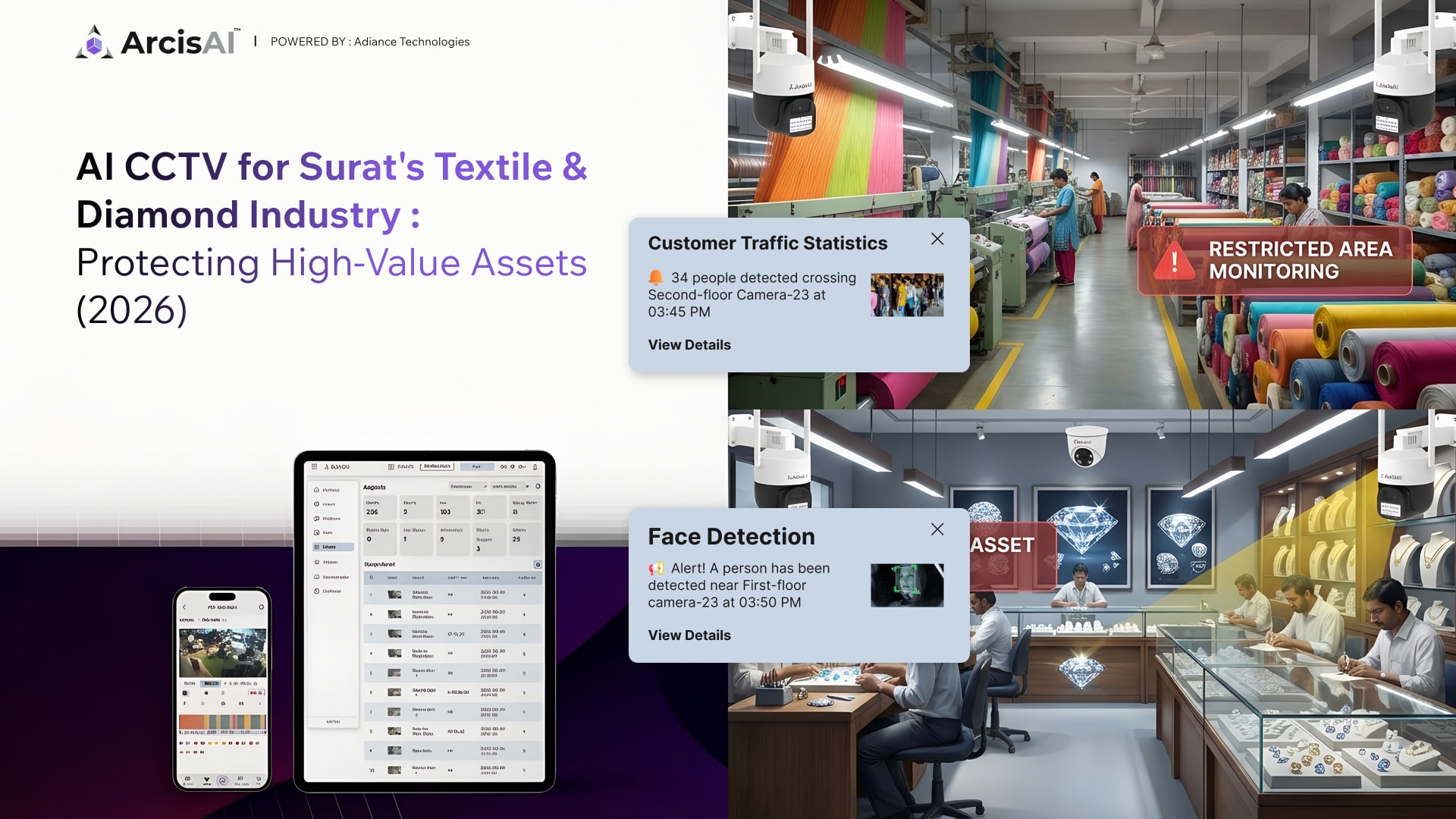
Surat's diamond cutting and polishing units and its vast textile and saree manufacturing clusters face a shared security challenge: enormous concentrations of high-value, portable assets — loose diamonds, gemstones, premium fabrics — moving across busy production floors, shared corridors, and multi-unit trading buildings every day. AI-powered CCTV addresses this with real-time intrusion alerts, zone-by-zone access monitoring, encrypted audit-trail footage, and multi-unit oversight from a single dashboard — giving Surat's business owners the protection their inventory demands without disrupting the speed their industry runs on.
Table of Contents
Why Does Surat's Diamond and Textile Industry Need Intelligent Surveillance?
What Security Challenges Do Diamond and Textile Units in Surat Face?
Industry Risk to ArcisAI Feature: Quick Reference
How Does ArcisAI Deliver Surveillance for Surat's Diamond and Textile Sector?
What Should Surat Diamond and Textile Businesses Look for When Buying AI CCTV?
Why Does Surat's Diamond and Textile Industry Need Intelligent Surveillance?
Surat occupies a unique position in Indian and global trade. The city cuts and polishes more than 90 percent of the world's diamonds — operations concentrated in Varachha and Katargam, where thousands of small and mid-sized units handle loose stones worth lakhs to crores of rupees daily. Alongside this, Surat's Pandesara and Udhna belt is home to one of India's largest textile and synthetic saree manufacturing clusters, where high-value fabric inventory, embroidery stock, and finished goods move through mills, godowns, and trading complexes in large volumes.
The security risk profile these industries share is distinct from a generic factory or warehouse. The assets are:
• Small and concealable — a handful of polished diamonds or a bolt of premium fabric can leave a premises in a pocket or bag.
• High in unit value — a single incident of pilferage or theft can mean a loss that dwarfs months of operating profit.
• Handled by large workforces — production floors in both industries involve dozens to hundreds of workers in close proximity to high-value stock.
• Spread across multiple units — many Surat businesses operate from several floors of a shared building or across multiple locations in the same industrial cluster.
A conventional CCTV system — cameras that record passively and require manual review after an incident — does not match this risk environment. By the time footage is reviewed, the loss has already occurred. What Surat's diamond and textile businesses need is surveillance that detects, alerts, and creates a verifiable record in real time.
What Security Challenges Do Diamond and Textile Units in Surat Face?
How Can AI CCTV Protect Against Pilferage of Small, High-Value Assets?
In a diamond cutting or polishing unit, the primary internal theft risk is the removal of small stones — individually or incrementally over time. In a textile unit, it is the removal of premium fabric rolls, zari thread, or finished sarees. Both risks share a common characteristic: the items are small enough that a conventional perimeter camera cannot detect the theft event itself, only the person who may have committed it.
AI surveillance addresses this through a combination of capabilities:
• Missing object detection — cameras monitor designated storage areas, sorting tables, or inventory racks for the disappearance of specific objects or stacks. When an item that was present is no longer visible, the system flags the change and logs a timestamped alert — before anyone has reviewed footage manually.
• Zone access monitoring with intrusion alerts — restricted areas (vault rooms, finished-goods storage, diamond grading rooms) are configured with virtual perimeters. The moment an unauthorised person enters, an instant alert reaches the supervisor's phone via the mobile app.
• Line-crossing alerts — doorways, stairwells, and corridor checkpoints can be configured as virtual lines. Anyone crossing in a restricted direction or at an unauthorised time generates an automatic alert.
These detections run on the camera itself through edge AI — no cloud connection required for the alert to fire, and no delay from video travelling to a remote server and back.
How Can CCTV Help Manage Worker Zones and Access Control in Production Areas?
Both diamond and textile production involve highly specialised zones — grading rooms, polishing sections, finishing departments, raw material stores — where only specific workers should be present at specific times. Managing this manually across a multi-floor or multi-unit operation is extremely difficult.
AI surveillance supports zone management with:
• Face recognition at entry points (where lawfully deployed) — cameras at restricted zone entrances verify that the person attempting entry is authorised, generating access logs with timestamps automatically. This creates an audit trail showing exactly who was present in each zone at any given time — invaluable for incident investigations.
• Human detection with role-specific alerts — the system can be configured to alert when a person is detected in an area they should not occupy during a particular shift or time window.
• People counting analytics — headcount monitoring at production zone entries tracks how many personnel are present in each area at any moment, supporting both access control and occupancy management.
What Is the Risk at Gates and Entry Points for Surat Industrial Units?
Diamond units and textile mills typically operate within shared industrial estates or multi-tenant buildings where vehicle and pedestrian access is not always tightly controlled. Delivery vehicles, contractors, visitors, and casual labour may all access a facility on any given day. Without automated gate monitoring, it is difficult to maintain a reliable record of who entered and when.
ANPR (Automatic Number Plate Recognition) cameras at vehicle entry points read and log every arriving and departing vehicle's number plate automatically. The system matches plates against an authorised or flagged list and alerts security staff to any unrecognised or blacklisted vehicle — creating a complete, searchable vehicle access log without manual effort.
For pedestrian entry, face recognition at access points creates an equivalent log for personnel.
Industry Risk to ArcisAI Feature: Quick Reference
Surat Industry Security Risk — ArcisAI Feature That Addresses It — Processing Mode
Theft of loose diamonds or gemstones from sorting/grading tables — Missing object detection with instant alert — Edge AI
Unauthorised entry into diamond vault or finished-goods storage — Intrusion detection, virtual zone perimeters — Edge AI
Worker accessing a zone they are not cleared for — Face recognition at restricted entry points, zone access logs — Cloud AI
Pilferage of premium fabric rolls or zari from textile stores — Missing object detection, zone monitoring — Edge AI
After-hours movement in production areas or godowns — Human detection with push alerts (24/7, low-light capable) — Edge AI
Vehicle entering industrial premises without authorisation — ANPR gate camera — alerts for unrecognised plates, full entry log — Cloud AI
Abandoned bags or items in sensitive areas — Abandoned object detection — Edge AI
Crowd or gathering near high-value storage areas — Crowd detection alert — Edge AI
Multi-unit oversight (several floors or locations, one owner) — Cloud VMS — all cameras, one dashboard, one login — Cloud
Searchable audit trail for insurance or police investigation — ArcisGPT footage search, encrypted STQC-certified VMS logs — Cloud AI
Dust or heat on mill floors damaging camera hardware — IP66/IP67 rated Eco-Series and S-Series cameras — Hardware
4G connectivity where cabling is impractical — Eco-Series with 4G option — Hardware
Existing cameras already installed — avoid full replacement — Bridge Device retrofit — adds AI to non-AI cameras — Hardware
How Does ArcisAI Deliver Surveillance for Surat's Diamond and Textile Sector?
What Camera Hardware Is Suitable for Diamond and Textile Unit Environments?
ArcisAI offers two hardware series suited to the varied environments of Surat's industrial clusters:
S-Series — Edge AI cameras with on-device processing for real-time intrusion detection, human and vehicle classification, line-crossing, crowd detection, and abandoned/missing object alerts. Alerts fire on the camera itself, independently of any cloud connection. This is the primary choice for diamond and textile production floors where instant, reliable alerting on restricted zone access is the priority.
Eco-Series — Available in 3MP, 5MP, and 8MP resolutions with WiFi, PoE (Power over Ethernet), and 4G connectivity options. Rated IP66/IP67, providing full dust and water ingress protection — relevant for textile mill environments where fibre dust, moisture from dyeing processes, and high ambient heat can degrade conventional camera hardware. The 4G option makes these cameras deployable in locations within a building or compound where running cable is impractical.
For units that already have legacy cameras installed, the ArcisAI Bridge Device connects to existing non-AI cameras and adds edge AI processing — delivering intrusion detection, human detection, and other analytics without replacing the hardware already in place. This is a practical route for Surat business owners who installed cameras relatively recently and do not want to write off that investment.
Recording is supported by NVR units from 4 to 32 channels, scaling from a single small unit to a large multi-floor or multi-location operation.
How Does ArcisAI Protect Footage Integrity and Support Audit Trails?
For the diamond industry in particular, footage integrity is not just a security consideration — it is a business and insurance requirement. If a loss is reported to a carrier, to police, or to a trading association, the credibility of the surveillance record is central to any investigation.
ArcisAI's Video Management Software is STQC-certified, meeting India's six Essential Requirements for surveillance cybersecurity, which include:
• Encrypted video transmission (TLS/HTTPS) — footage cannot be intercepted or tampered with in transit.
• Cryptographically signed firmware — the camera's operating software cannot be silently modified.
• No default passwords — cameras require secure credential setup before operation.
• Disabled debug ports in production units — no unauthorised backdoor access to hardware.
• Role-based access with audit logging — every login, live-view, and footage download action is recorded with a timestamp and user identity.
This means that when a business needs to produce footage as evidence — to police, to an insurer, or to a trading partner — the record can be shown to be genuine, unmodified, and securely held.
Can Multiple Units or Locations Be Managed from a Single Dashboard?
Yes. Many Surat diamond traders and textile manufacturers operate across several floors of a shared building, or maintain separate manufacturing and warehouse locations within the same cluster. ArcisAI's Cloud VMS allows all cameras across all locations to be viewed and managed through a single login — no need to switch between separate systems for each site.
ArcisGPT, ArcisAI's natural-language footage search interface, lets business owners or security managers query the system conversationally: "Show me any activity in the vault room after 8 PM yesterday" or "Which cameras detected movement in the fabric store between midnight and 5 AM this week?" — without requiring specialist operator training or manual clip-by-clip review.
What Should Surat Diamond and Textile Businesses Look for When Buying AI CCTV?
When evaluating AI surveillance systems for a high-value asset environment, go beyond camera resolution and check for these specific capabilities:
1. Edge AI with on-device alerting. In a diamond unit where the value of a single incident can run to lakhs, you need alerts that fire in seconds — not after footage has made a round-trip to a cloud server. Cameras that process on-device deliver this. Ask vendors specifically whether detection and alerting happens on the camera or only in the cloud.
2. Missing and abandoned object detection. This is the capability most directly relevant to small-asset protection. Verify that the system can detect when a specific object that was present in a monitored area is no longer there — and alert automatically, without manual review.
3. Encrypted, tamper-evident footage. For any incident that may involve insurance claims or police investigation, you need footage that cannot be questioned for authenticity. Look for STQC-certified VMS as a baseline.
4. BIS-ER certified hardware. Under India's ER-01:2024 regulations, all CCTV cameras sold and deployed in India must carry BIS-ER registration. This is not just a compliance requirement — it ensures the camera meets India's cybersecurity standards for surveillance hardware, including supply-chain transparency and secure firmware. Verify the registration number at crsbis.in or lims.bis.gov.in before purchasing.
5. IP66/IP67 rating for mill environments. Textile mills generate fibre dust, operate dyeing and finishing processes that produce moisture, and can reach high ambient temperatures. Standard cameras degrade in these conditions. Insist on IP66 as a minimum for any camera installed on a production floor or in an industrial godown.
6. Multi-location dashboard. If your business spans multiple floors, buildings, or locations, a system that requires you to log into different software instances for each site is a practical obstacle to effective oversight. A unified cloud VMS that consolidates all locations in one view is the standard to require.
7. Local Gujarat support. A surveillance system is only as good as its ongoing maintenance and support. ArcisAI's headquarters is in Ahmedabad — meaning the Gujarat business community has access to local technical expertise, shorter response times, and support staff who understand the region's business environment.
Frequently Asked Questions
Table of Contents
Why Does Surat's Diamond and Textile Industry Need Intelligent Surveillance?
What Security Challenges Do Diamond and Textile Units in Surat Face?
Industry Risk to ArcisAI Feature: Quick Reference
How Does ArcisAI Deliver Surveillance for Surat's Diamond and Textile Sector?
What Should Surat Diamond and Textile Businesses Look for When Buying AI CCTV?
Send Us a Message