AI CCTV for Smart Cities & Government Projects in Maharashtra (2026)
Kushal Sanghvi
Updated●June 2, 2026
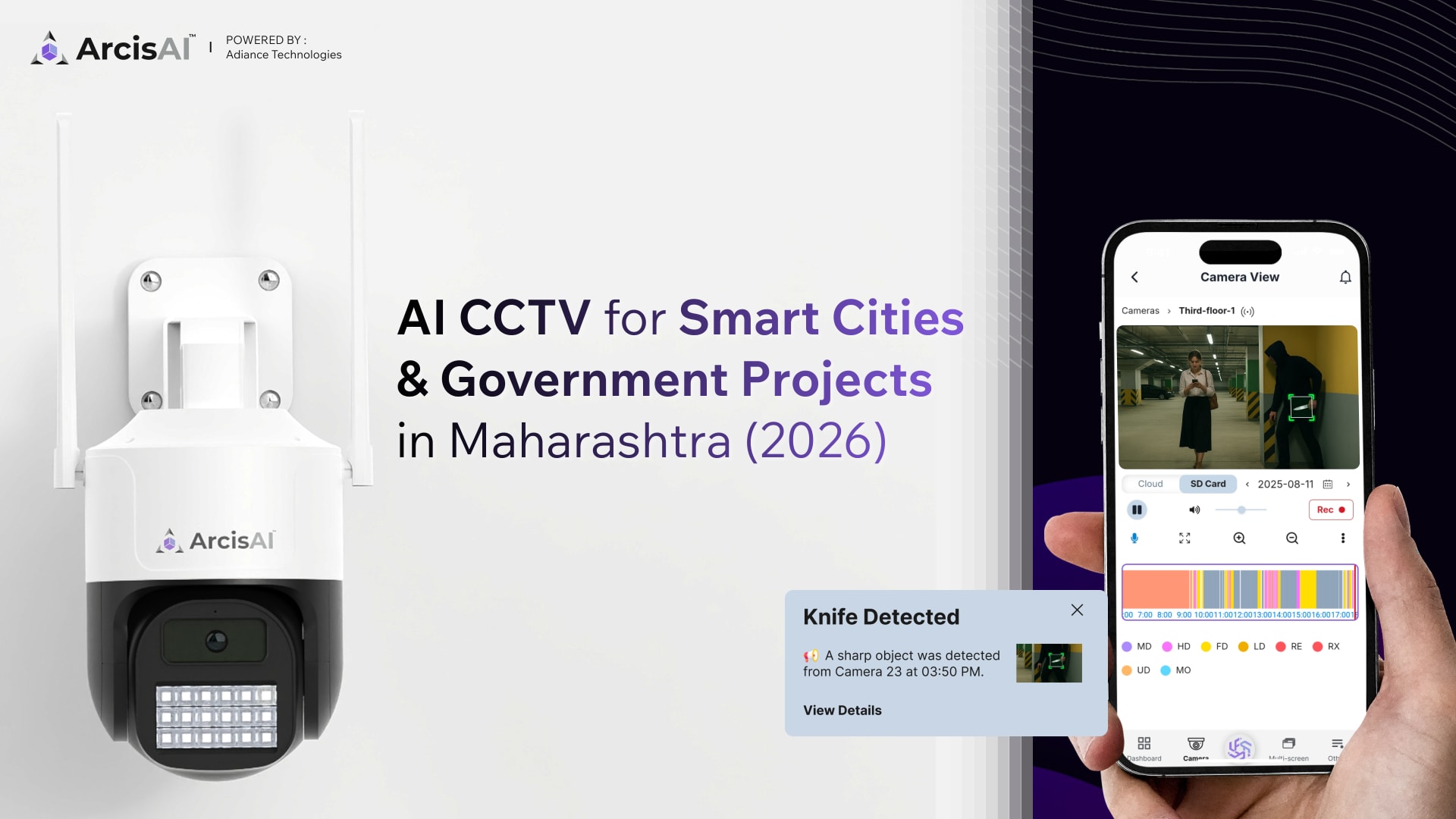
Maharashtra — and Mumbai in particular — is deploying AI-powered CCTV across thousands of city cameras, integrated into Integrated Command and Control Centres (ICCCs) for real-time traffic, public-safety, and emergency-response management. For government agencies, municipal bodies, and PSUs procuring surveillance systems in 2026, the mandatory requirements are clear: STQC-certified VMS, BIS-ER registered hardware, GeM-listed supply, Made-in-India preference, and data hosted on Indian servers. ArcisAI meets all of these requirements and is purpose-built for large-scale, multi-agency ICCC deployments.
Table of Contents
Why Is Maharashtra at the Centre of India's Smart City Surveillance Push?
What Does an AI-First Smart City Surveillance System Actually Do?
Smart City Need to ArcisAI Capability: Reference Table
Procurement and Compliance: What Maharashtra Government Buyers Need to Know
Government Procurement Checklist for Smart City CCTV in Maharashtra
Why Is Maharashtra at the Centre of India's Smart City Surveillance Push?
Maharashtra consistently ranks among India's highest-investment states for urban infrastructure. Mumbai's scale — one of the world's most densely populated metros — makes city-wide surveillance both a significant operational challenge and an immediate public-safety priority.
Across Maharashtra's Smart City Mission-designated cities, the core infrastructure programme includes deploying large fleets of IP cameras connected to ICCCs: central nerve centres where city managers, traffic police, emergency services, and municipal administrators share a unified, real-time operational picture. A single ICCC can integrate feeds from hundreds or thousands of cameras across an entire city, supplemented by AI analytics that convert raw video into actionable intelligence — traffic density, crowd build-up, incidents, ANPR checks at key junctions.
The scale and strategic importance of these programmes means that procurement standards have become increasingly rigorous. A smart-city camera system purchased in 2026 must meet India's current national security, interoperability, and data-sovereignty requirements — not just deliver a good image.
What Does an AI-First Smart City Surveillance System Actually Do?
How Does AI Improve Public Safety Beyond Basic Camera Recording?
Traditional CCTV in public spaces records events for review after they occur. AI surveillance transforms those cameras into proactive assets: systems that detect, classify, and alert in real time — without requiring a human operator to watch every feed simultaneously.
For a Maharashtra smart-city deployment, the AI capabilities that matter most include:
• ANPR (Automatic Number Plate Recognition): Real-time reading and cross-checking of vehicle number plates at intersections, toll points, entry corridors, and sensitive zones. Generates instant alerts for blacklisted or flagged vehicles.
• Crowd and headcount analytics: Continuous estimation of crowd density at public spaces, transport hubs, and event venues — enabling early warnings before a gathering becomes a public-safety risk.
• Vehicle classification: Distinguishes car, two-wheeler, bus, truck, and autorickshaw — critical for traffic flow analysis and mixed-traffic signal optimisation on Maharashtra's urban roads.
• Fire and smoke detection: Early visual detection in public infrastructure — stations, markets, heritage areas — where conventional smoke detectors may not provide adequate coverage.
• Weapon detection: Alerts city-control operators when cameras detect objects associated with potential security threats in sensitive public locations.
• Intrusion detection: Perimeter protection for government buildings, infrastructure assets, substations, and restricted zones.
All of these detections can run in two modes: edge AI — on the camera itself, delivering sub-second local alerts even without cloud connectivity — or Cloud AI, where more compute-intensive models run centrally and feed a city-wide dashboard.
What Is ArcisGPT and Why Does It Matter for ICCC Operators?
An ICCC managing thousands of camera feeds across a city faces a real human limitation: no team of operators can watch every feed simultaneously, and searching recorded footage manually for a specific vehicle, person, or event is time-consuming.
ArcisGPT is ArcisAI's natural-language interface for city surveillance operators. Rather than navigating clip-by-clip through recorded footage, an operator can query the system in plain language:
• "Show me any instances of crowd density exceeding threshold at Dadar station between 6 PM and 9 PM yesterday."
• "Which cameras detected vehicle MH-01-XX-0000 today?"
• "Flag all fire detection alerts in the Dharavi zone from the last 48 hours."
ArcisGPT surfaces the relevant footage, timestamps, and alert records in seconds — reducing investigative workload and enabling faster, evidence-based response. For cities managing large multi-thousand-camera estates, this capability is not a convenience feature: it is a force multiplier for the operator team.
Smart City Need to ArcisAI Capability: Reference Table
Smart City / ICCC Requirement — ArcisAI Capability — Deployment Mode
Real-time traffic monitoring at junctions — ANPR + vehicle classification — Edge AI / Cloud AI
Crowd density monitoring at public spaces — Headcount and crowd detection — Cloud AI
Emergency vehicle priority and incident mapping — ANPR alerts + ICCC integration via API — Cloud AI
Perimeter protection of govt. buildings and utilities — Intrusion detection, line-crossing — Edge AI
Fire/smoke detection at public infrastructure — Cloud AI fire and smoke detection — Cloud AI
Weapon or threat detection at sensitive locations — Cloud AI weapon detection — Cloud AI
Unified operator view across entire city camera estate — Cloud VMS with multi-feed dashboard — Cloud / Hybrid
Natural-language footage search for investigators — ArcisGPT conversational interface — Cloud AI
Integration with existing ICCC hardware/software — STQC-certified VMS + open API — On-prem / Hybrid
Scalable for multi-city or state-level deployment — Cloud-native, unlimited-camera licensing — Cloud
Face recognition for authorised law-enforcement use — Cloud AI (where lawful and authorised) — Cloud AI
On-prem deployment for data-sensitive facilities — On-premise VMS option — On-prem
Hybrid deployment across sites of varying connectivity — Cloud / edge / on-prem in same estate — Hybrid
Procurement and Compliance: What Maharashtra Government Buyers Need to Know
For any government or PSU surveillance procurement in Maharashtra in 2026, the compliance checklist has never been more clearly defined. Here is what to verify before shortlisting any vendor.
Is STQC and BIS-ER Certification Mandatory for Smart City CCTV Tenders?
Yes. Under the ER-01:2024 framework (effective April 2026), all CCTV hardware sold in India must carry BIS-ER registration from the Bureau of Indian Standards. For government and PSU procurement specifically, STQC certification from MeitY's Standardisation Testing and Quality Certification Directorate is a mandatory additional requirement.
These certifications confirm that the hardware and software meet India's six Essential Requirements for surveillance cybersecurity:
1. No default passwords active after first login
2. Encrypted video transmission (TLS/HTTPS)
3. Cryptographically signed firmware (secure boot)
4. Disabled debug ports in production units
5. Disclosed chipset and supply-chain origin
6. Published vulnerability-disclosure policy
ArcisAI certification status:
• BIS-ER: Registration number R-72003735 (ER01:2024) — verifiable at crsbis.in / lims.bis.gov.in
• STQC: Certified VMS — verifiable at stqc.gov.in
Always verify certificate numbers directly on the official portals. Do not rely solely on vendor-supplied PDFs.
Is ArcisAI Available on the Government e-Marketplace (GeM)?
Government procurement in India is increasingly routed through the Government e-Marketplace (GeM), which provides a standardised, transparent purchasing pathway for central and state government agencies, municipal corporations, and PSUs. Procurement through GeM also satisfies Make-in-India preference requirements for domestic suppliers.
ArcisAI is designed and positioned for GeM procurement. Government buyers should confirm current listing status and product SKUs directly at gem.gov.in at the time of procurement, as catalogue listings are updated periodically.
Does ArcisAI Meet the Make-in-India Requirement for Government Surveillance Projects?
Yes. ArcisAI hardware is Made in India, manufactured by Adiance Technologies (Ahmedabad, founded 2003). The Make-in-India and Atmanirbhar Bharat directives give preference to domestically manufactured electronics and software in government procurement — an area where ArcisAI is positioned as a first-tier option.
This is particularly relevant for large smart-city programmes where the Government of India's digital-infrastructure policies actively encourage domestic technology suppliers.
Where Is City Surveillance Data Stored? Does ArcisAI Support Data Localisation?
Data sovereignty is a core requirement for government and PSU surveillance deployments. City camera footage, metadata, ANPR logs, and AI event records must remain within India's borders — they cannot be routed through or stored on foreign servers.
ArcisAI operates on Indian cloud servers, ensuring that all video data and analytics remain within India's jurisdiction. For deployments with additional security requirements, ArcisAI also supports on-premise VMS installation, where data never leaves the agency's own infrastructure. Hybrid configurations — edge recording locally, analytics in Indian cloud — are also supported.
Is ArcisAI NDAA Compliant?
Yes. NDAA compliance confirms that ArcisAI hardware does not include components from suppliers that have been restricted under US National Defense Authorization Act provisions. For Indian government agencies with international partnerships, export-oriented PSUs, or facilities operated in conjunction with foreign entities, NDAA compliance is an additional risk-management assurance. It also signals supply-chain transparency — the same commitment embedded in India's own ER-01:2024 requirements.
Government Procurement Checklist for Smart City CCTV in Maharashtra
Use this checklist when evaluating vendors for any government, municipal, or PSU CCTV tender in Maharashtra:
Requirement — What to Verify — Where to Check
BIS-ER hardware registration — Registration number for cameras and NVRs — crsbis.in / lims.bis.gov.in
STQC VMS certification — Certificate reference for VMS software — stqc.gov.in
Make-in-India status — Manufacturing location, PLI/MII declaration — Vendor documentation
GeM availability — Product listed and orderable on GeM — gem.gov.in
NDAA compliance — Supplier declaration, component origin — Vendor documentation
Indian-server data hosting — Data processing and storage within India — Vendor SLA / data processing agreement
On-prem deployment option — VMS installable on agency infrastructure — Vendor technical documentation
ICCC integration capability — API documentation, existing integrations — Vendor technical team
Edge AI support — On-camera inference without cloud dependency — Product specification sheet
Scalability — Maximum cameras per deployment, licensing model — Vendor proposal
Frequently Asked Questions
Table of Contents
Why Is Maharashtra at the Centre of India's Smart City Surveillance Push?
What Does an AI-First Smart City Surveillance System Actually Do?
Smart City Need to ArcisAI Capability: Reference Table
Procurement and Compliance: What Maharashtra Government Buyers Need to Know
Government Procurement Checklist for Smart City CCTV in Maharashtra
Send Us a Message