AI CCTV for Schools & Educational Campuses (2026 Safety Guide)
Kushal Sanghvi
Updated●June 3, 2026
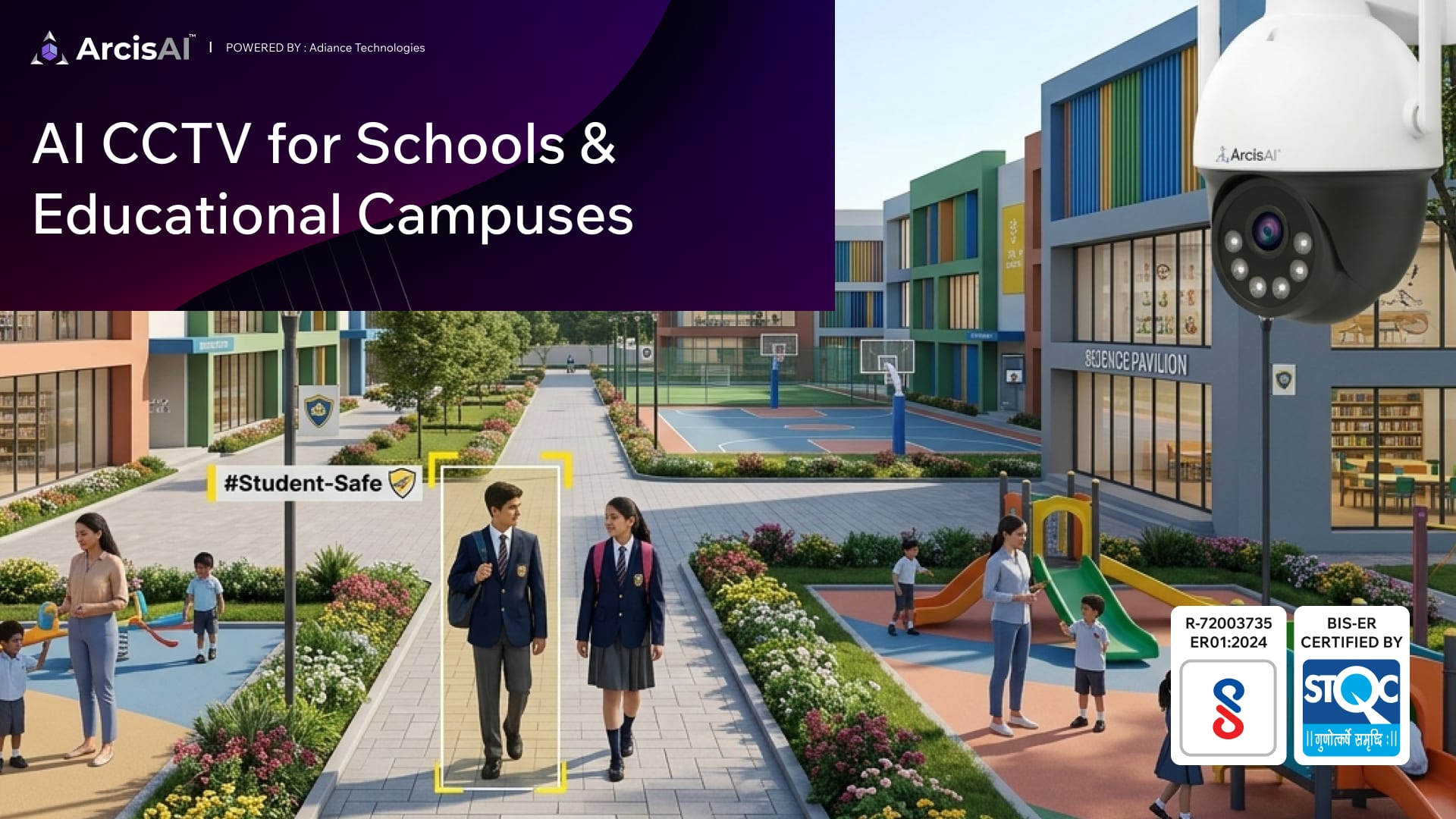
AI CCTV for schools goes well beyond recording — it actively monitors entry points, detects intruders after hours, and helps staff review incidents quickly and accurately. For Indian schools and college campuses, a properly designed AI camera system protects students and staff, reassures parents, and gives administrators real-time visibility across every part of the premises, all from a single mobile-accessible dashboard.
Why Is Standard CCTV No Longer Enough for a School or College Campus?
Educational institutions are complex, high-footfall environments. A mid-size school may have hundreds of students arriving and leaving at predictable times, dozens of staff, contractors, delivery personnel, and parent visitors moving through the premises daily. A university campus may span multiple buildings, parking areas, hostels, and sports facilities spread across several acres.
Traditional CCTV systems record these movements faithfully. What they cannot do is act on what they record — they do not send an alert when a stranger lingers near the school gate, they do not flag when someone enters a restricted area after hours, and they do not help a principal quickly find the specific clip needed to understand what happened during a corridor incident.
AI-powered school security cameras change that equation. On-device edge AI processes video in real time, generating alerts the moment a defined situation arises, while cloud VMS software gives administrators the ability to search footage using plain language and manage every camera on campus from a single screen.
What Are the Key Security Needs on a School or College Campus?
A comprehensive campus surveillance plan needs to address several distinct zones and risk categories, each with specific requirements.
Can AI CCTV Make School Entry Gates and Visitor Management Safer?
The main gate is the first and most critical line of defence for any educational campus. AI CCTV with Automatic Number Plate Recognition (ANPR) logs every vehicle entering and leaving, matching plates against approved lists — parent vehicles, staff cars, authorised contractors — and flagging unknown vehicles for immediate attention. For schools running dedicated bus fleets, ANPR provides an automatic record of every bus arrival and departure, giving transport coordinators real-time visibility without manual logbooks.
Pedestrian entry points benefit from human detection and line-crossing alerts: if a visitor attempts to bypass the reception desk or enter through a side gate after hours, the system alerts security staff immediately rather than recording the breach for review the following day.
How Does AI CCTV Protect the Campus Perimeter?
A perimeter breach at night — or during holidays and exam-free periods — is a common risk at schools and colleges, particularly those with large grounds or multiple boundary walls. AI intrusion detection combined with loitering alerts means that if anyone climbs a wall or approaches the perimeter fence, security staff receive an alert in seconds. After-hours human detection with push notifications to the security guard's mobile device provides a reliable, fatigue-proof watch that does not depend on a guard staying alert through the night.
What Role Does Surveillance Play in Corridors, Common Areas, and Classrooms?
Corridors, staircases, canteens, and common rooms are where most day-to-day incidents on campus occur — both in terms of student wellbeing and property security. AI cameras in these areas support:
• Incident review — when a staff member needs to understand what happened during an altercation or accident, ArcisGPT's natural-language footage search retrieves the relevant clip in seconds rather than requiring hours of manual scrubbing.
• Crowd and congestion detection — identifying unusual crowd build-up in a corridor or stairwell during an emergency or assembly scenario.
• Restricted-area protection — alerting staff if students or unauthorised personnel enter server rooms, labs with hazardous materials, or staff-only zones.
It is important to note that camera placement in educational settings should strictly follow appropriate-area guidelines. Cameras are deployed in common areas, corridors, entry/exit points, and external spaces only — never in areas where privacy is reasonably expected, such as washrooms, changing rooms, or medical rooms.
How Can AI CCTV Support Anti-Bullying and Pastoral Care Efforts?
When a concern about student behaviour is raised — whether by a student, parent, or staff member — the ability to review footage quickly and accurately is invaluable. ArcisGPT allows school administrators to query footage using natural language: "Show me activity near the science block corridor between 1 PM and 2 PM on Thursday." This transforms what could be a lengthy, inconclusive investigation into a factual review that protects both the student raising the concern and the student about whom a concern has been raised.
This capability supports pastoral care responsibly: it is a tool for accountability and accurate record-keeping, not for continuous monitoring of student behaviour.
Is AI CCTV Effective for School Bus Bays and Parking Areas?
Bus bays and parking areas present specific challenges — high vehicle density during drop-off and pick-up, limited staff supervision, and the risk of unauthorised vehicles entering zones reserved for school transport. ANPR cameras at parking entry points automate vehicle identification and access control. AI cameras covering the bus bay detect loitering near vehicles and generate alerts if individuals are present in the bay outside permitted arrival and departure windows.
How Does AI CCTV Support Emergency Response on a Campus?
When an emergency occurs — a medical incident, a fire evacuation, or an unauthorised person on campus — the speed at which administrators can access accurate information is critical. Cloud VMS with mobile access means a principal or security manager does not need to be physically in the control room to view live feeds from across the campus. ArcisGPT allows first responders or administrators to instantly retrieve footage of a specific area or time window during or after an incident.
AI crowd detection can also support emergency evacuations by flagging areas where people are congregating unexpectedly, helping staff direct evacuation routes in real time.
Campus Area Coverage: AI Features at a Glance
Campus Zone / Concern — Recommended AI Feature
Main gate — vehicle access control — ANPR for known/unknown vehicle identification
Main gate — pedestrian entry management — Human detection, line-crossing alert
Perimeter wall / boundary fence — Intrusion detection, after-hours human detection
Corridors and common areas — Crowd detection, loitering alert, incident clip search via ArcisGPT
Restricted areas (labs, server rooms, staff zones) — Intrusion detection, push alerts
Bus bay and parking — ANPR, loitering detection outside permitted hours
Sports grounds and open spaces — Perimeter line-crossing, after-hours intrusion
After-hours campus-wide monitoring — Human detection with mobile push alerts, Bridge Device retrofit
Emergency and incident response — Live mobile view via Cloud VMS, ArcisGPT footage search
What Should School and College Decision-Makers Look for in a Campus CCTV System?
Choosing a campus surveillance system is a significant, long-term investment. These criteria will help administrators and procurement teams evaluate options carefully.
1. Edge AI with reliable on-campus processing
Alerts generated on the camera itself are faster and work even if the internet connection is temporarily disrupted. This matters especially for perimeter and gate cameras where real-time response is most critical.
2. Natural-language footage search
Administrators and pastoral staff are not IT professionals. A system that requires technical VMS training to review footage will be underused. ArcisGPT's conversational search interface means any authorised staff member can find relevant clips without specialist training.
3. Certifications and compliance
For a government school, aided institution, or regulated university, procurement compliance matters. Look for BIS-ER certified hardware and STQC-certified VMS software. ArcisAI hardware carries BIS-ER certification (R-72003735 ER01:2024), and its VMS is STQC-certified. NDAA compliance is relevant for institutions with international affiliations or funding.
4. Made in India
India-manufactured hardware supports domestic supply chain integrity, typically offers stronger local service and support, and aligns with government procurement preferences under Make in India initiatives.
5. Scalability across multiple buildings and campuses
A university or school chain may need to manage hundreds of cameras across multiple locations. Ensure the VMS supports multi-site management from a single login, and that the system can grow without requiring a platform replacement.
6. Privacy-by-design deployment
A responsible CCTV partner will provide clear deployment guidelines — covering appropriate camera placement, data retention policies, and transparency to staff, students, and parents. Cameras should be placed only in areas where their presence is appropriate and expected. Avoid vendors who are vague about these responsibilities.
7. Retrofit capability
Many schools and colleges already have legacy analogue or older IP cameras. The ArcisAI Bridge Device adds AI analytics and cloud connectivity to existing hardware, protecting the institution's prior investment while delivering modern capabilities.