AI CCTV for Retail Stores: Reduce Shrinkage and Run a Safer Shop (2026)
Kushal Sanghvi
Updated●June 2, 2026
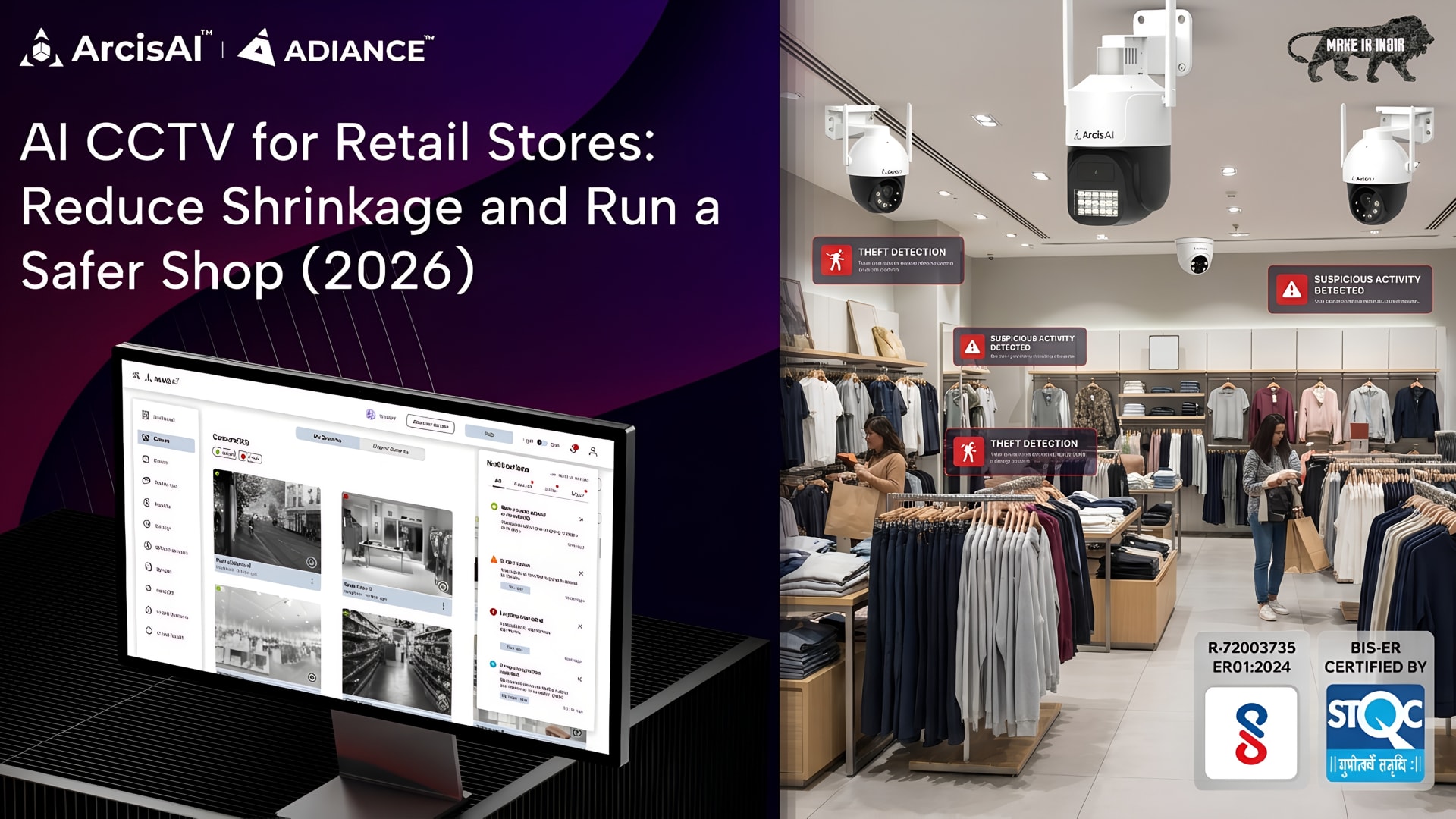
AI-powered CCTV for retail stores goes beyond recording footage — it actively detects suspicious behaviour, counts footfall, flags blind spots, and gives store owners real-time alerts on a mobile app. For Indian retailers dealing with shrinkage, staff safety concerns, and multi-branch oversight, an AI camera system delivers measurable protection and actionable business insight, all from a single dashboard.
Table of Contents
Why Does Every Retail Store Need Smarter Surveillance Today?
How Does AI CCTV Reduce Shoplifting in a Retail Store?
What Retail Challenges Can AI CCTV Actually Solve?
How Does People Counting Help a Retail Business?
What Is ArcisGPT and How Does It Work for Retailers?
Which ArcisAI Camera Is Right for a Retail Store?
What Should a Retail Buyer Look for in a Shop Security Camera System?
Why Does Every Retail Store Need Smarter Surveillance Today?
Retail theft and shrinkage are among the most persistent cost pressures for Indian shop owners, whether you run a standalone kirana, a fashion outlet, or a multi-city supermarket chain. Industry estimates consistently place shrinkage — covering shoplifting, internal theft, vendor fraud, and administrative errors — at 1–3% of annual revenue. For a store turning over ₹1 crore a year, that is ₹1–3 lakh walking out the door.
Traditional CCTV records what happened. AI CCTV acts on what is happening. That shift — from passive recording to active intelligence — is what makes modern shop security cameras genuinely valuable for retail operators.
How Does AI CCTV Reduce Shoplifting in a Retail Store?
Shoplifting thrives on inattention — busy staff, crowded aisles, poorly lit corners. AI surveillance closes those gaps automatically.
Modern edge AI cameras process video directly on the device, without sending every frame to the cloud. This means instant, on-device detection of:
• Intrusion detection — alerts when someone enters a restricted area (stockroom, cash counter zone) without authorisation.
• Line-crossing alerts — triggers a notification the moment a defined boundary is crossed, even during peak shopping hours.
• Loitering and crowd detection — flags individuals who linger near high-value display areas longer than expected, giving staff time to engage proactively.
• Abandoned and missing object detection — identifies when a product is removed from a shelf and not taken to the billing counter, or when a bag is left unattended.
Because these detections happen at the camera level, alerts reach the store manager's mobile app in seconds — not after reviewing recordings the next morning.
What Retail Challenges Can AI CCTV Actually Solve?
Retail Pain Point — AI Feature That Helps
Shoplifting and product theft — Intrusion detection, line-crossing alerts, loitering detection
After-hours break-ins — Human detection with instant push alerts, perimeter intrusion
Queue build-up at billing counters — People counting and crowd density analytics
Staff safety incidents — Real-time human detection in restricted zones, incident logging
Footfall and conversion insight — People/headcount counting, gender analytics for merchandising
Multi-store visibility from HQ — Cloud VMS dashboard and mobile app with all branches in one view
Upgrading existing legacy cameras — Bridge Device converts older cameras to AI-capable endpoints
Parking lot security — ANPR (Automatic Number Plate Recognition) for vehicle tracking
How Does People Counting Help a Retail Business?
A people counting camera does more than tally visitors — it turns footfall into a business metric.
Cloud AI analytics can track how many people enter your store per hour, per day, and per week. This data helps you:
• Optimise staffing — schedule more floor associates during proven peak hours instead of guessing.
• Measure campaign effectiveness — compare footfall before and after a promotional display or sale event.
• Improve store layout — identify which zones attract the most traffic and position high-margin products accordingly.
• Benchmark across branches — if your Ahmedabad outlet converts 40% of visitors and your Surat outlet converts 22%, you now have a specific question to investigate.
Gender analytics (where enabled and lawful) adds another layer, helping visual merchandising teams understand which product sections attract which customer segments.
What Is ArcisGPT and How Does It Work for Retailers?
Reviewing hours of footage after an incident is time-consuming and unreliable. ArcisGPT is a natural-language footage search tool that lets you query your camera system the way you would ask a colleague.
Instead of scrubbing through timelines, a store manager can type or speak a query such as:
• "Show me everyone who entered the stockroom after 9 PM yesterday."
• "Find footage of a person in a red jacket near aisle 3 between 2 PM and 4 PM."
• "Show all crowd alerts from the billing counter this week."
ArcisGPT retrieves the relevant clips in seconds. For retail loss prevention investigations, this compresses an hours-long task into minutes — and makes the evidence usable even for staff who are not technically trained in VMS software.
Which ArcisAI Camera Is Right for a Retail Store?
ArcisAI offers hardware designed to match different retail environments and budgets.
Eco-Series: Everyday Retail Coverage
The Eco-Series cameras (available in 3MP, 5MP, and 8MP resolution) cover the bulk of retail deployment scenarios. They are available in WiFi, PoE (Power over Ethernet), and 4G configurations, making them suitable for stores with structured IT infrastructure as well as those in locations where running ethernet cabling is impractical.
S-Series: Edge AI at the Camera
The S-Series cameras run AI detections on-device, which means faster alerts, lower bandwidth consumption, and reliable performance even if the internet connection drops temporarily. These are well-suited for high-value zones — jewellery display areas, stockrooms, or unmanned kiosks.
Bridge Device: AI-Upgrade Your Existing Cameras
Replacing every camera in an established store is costly. The ArcisAI Bridge Device connects to your existing analogue or IP cameras and adds AI analytics capabilities without hardware replacement. This is a practical path for retailers who want AI-powered detection without a full system overhaul.
NVRs and Cloud VMS
On-premise NVRs provide local storage and continued recording even during internet outages. Cloud VMS adds remote access, centralised management across all branches, and the ArcisGPT search layer. Both can work together for a hybrid setup.
What Should a Retail Buyer Look for in a Shop Security Camera System?
Before selecting an AI CCTV system for your retail store, evaluate these factors:
1. Edge vs. cloud AI processing
Edge AI (on-camera processing) delivers faster alerts and works during connectivity interruptions. Cloud AI unlocks richer analytics like footfall counting and cross-branch dashboards. The best systems offer both.
2. Certifications and compliance
In India, look for BIS-ER certified hardware and STQC-certified software. These certifications verify that the product meets Bureau of Indian Standards requirements and has been independently tested. ArcisAI hardware carries BIS-ER certification (R-72003735 ER01:2024) and its VMS is STQC-certified. NDAA compliance is relevant if your retail network has international partners or investors with US federal supply chain policies.
3. Made in India
Domestically manufactured hardware supports the PLI electronics ecosystem, typically has better local support and warranty service, and avoids supply chain risks associated with imported hardware.
4. Mobile app and remote access
Store owners and area managers need to check in without being physically present. A mobile app with live view, alert notifications, and clip review is not optional — it is a core requirement for any multi-location retailer.
5. Privacy and lawful use
AI features such as face recognition should be deployed strictly in compliance with applicable Indian law and with appropriate notice to customers and staff. Choose a vendor that provides clear guidance on lawful configuration, not one that glosses over these responsibilities.
6. Scalability
A system that works for one store should scale to fifty without requiring a platform change. Verify that the VMS and analytics platform support multi-site management from day one.
Frequently Asked Questions
Table of Contents
Why Does Every Retail Store Need Smarter Surveillance Today?
How Does AI CCTV Reduce Shoplifting in a Retail Store?
What Retail Challenges Can AI CCTV Actually Solve?
How Does People Counting Help a Retail Business?
What Is ArcisGPT and How Does It Work for Retailers?
Which ArcisAI Camera Is Right for a Retail Store?
What Should a Retail Buyer Look for in a Shop Security Camera System?
Send Us a Message