AI CCTV for Hospitals & Healthcare Facilities (2026 Guide)
Kushal Sanghvi
Updated●June 3, 2026
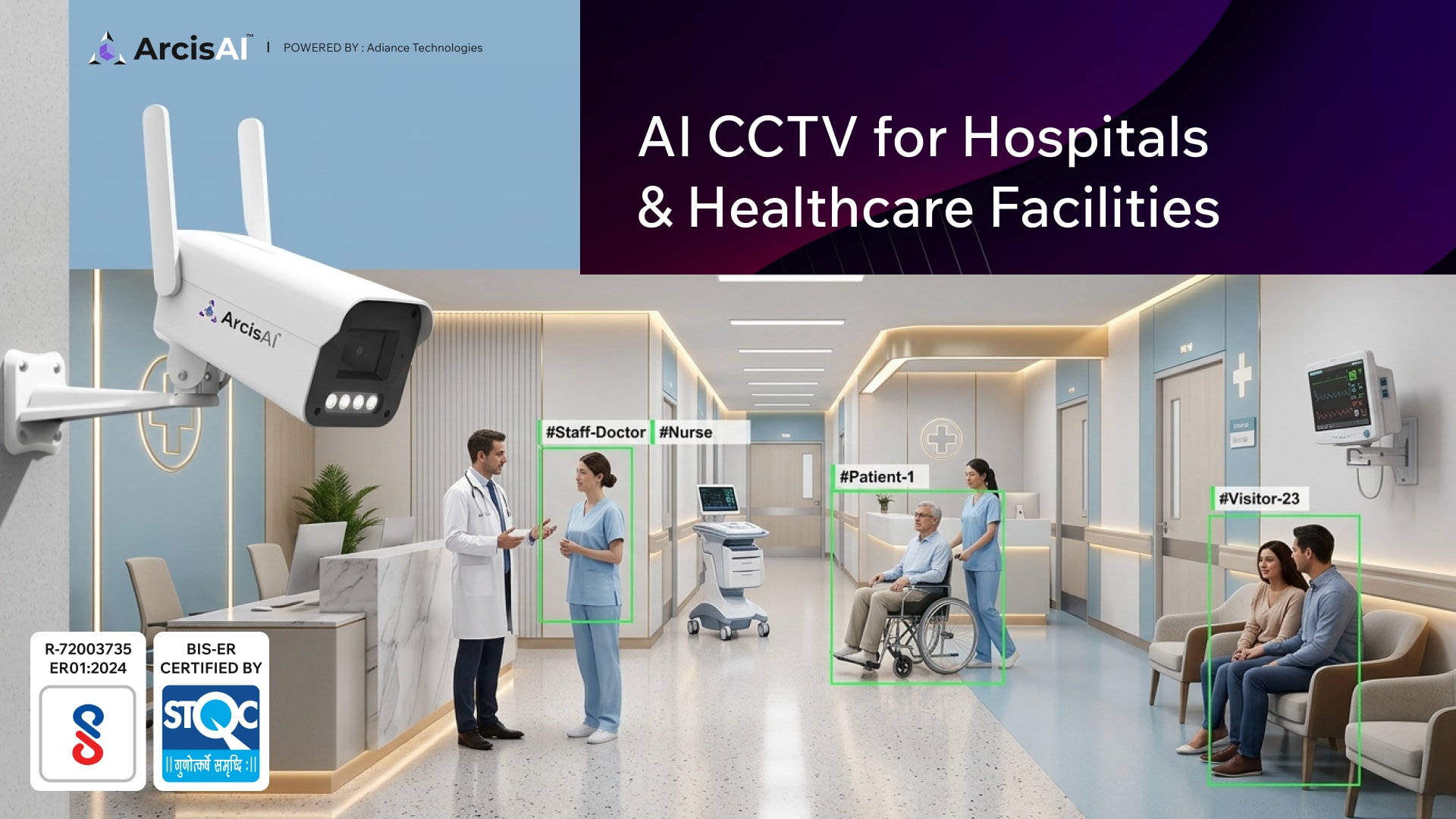
AI-powered CCTV for hospitals goes far beyond perimeter recording — it secures entry points, protects restricted clinical zones, monitors infant safety, guards pharmacy stores, and gives security teams instant, searchable alerts. For Indian healthcare facilities managing high footfall, round-the-clock operations, and strict regulatory accountability, a properly designed AI surveillance system is an essential part of patient safety, staff protection, and compliance infrastructure.
Table of Contents
Why Does Healthcare Surveillance Require a Purpose-Built Approach?
What Are the Biggest Security Gaps in a Hospital Today?
Which AI CCTV Feature Addresses Which Hospital Security Need?
How Does AI CCTV Protect Entry Points and Manage Hospital Visitors?
How Can AI Cameras Improve Safety in the Pharmacy and Restricted Drug Zones?
What AI CCTV Capabilities Protect Infant and Maternity Ward Corridors?
How Does ArcisGPT Help Hospital Security Teams Investigate Incidents?
What Should a Hospital Look for When Selecting an AI CCTV System?
Why Does Healthcare Surveillance Require a Purpose-Built Approach?
Hospitals and healthcare facilities present a security challenge unlike almost any other environment. They are simultaneously public spaces (open to patients and visitors), restricted clinical zones (ICUs, operation theatre corridors, pharmacies), high-value asset stores (medical equipment, controlled drugs), and spaces of genuine personal vulnerability.
Standard passive CCTV — cameras that record but do not analyse — cannot meet this challenge. A nurse asking the control room to review twelve hours of pharmacy corridor footage after a missing medication incident is not a security programme; it is an after-the-fact exercise in frustration.
AI surveillance changes that. By processing video at the camera level (edge AI) and at the cloud analytics layer, modern hospital security camera systems provide real-time detection, instant alerts, and natural-language investigation tools — so the security team can act before an incident escalates, and investigate efficiently when review is needed.
Privacy note: AI surveillance in healthcare must be deployed responsibly. Cameras should never be placed in clinical treatment areas, patient wards, changing rooms, or any space where patient dignity and medical confidentiality would be compromised. The deployments described in this guide relate exclusively to non-clinical corridors, entry points, storage areas, and facility perimeters. Healthcare organisations should verify applicable requirements under India's Digital Personal Data Protection Act (DPDPA), MoHFW guidelines, and any applicable state-level regulations before deployment.
What Are the Biggest Security Gaps in a Hospital Today?
Healthcare facilities across India consistently face several high-risk security scenarios:
• Unauthorised visitors accessing restricted zones after hours or without sign-in
• Drug diversion from pharmacy and controlled-substance storage
• Infant and neonate safety incidents in maternity wards
• Violence against healthcare workers — a persistent and growing concern
• Asset theft (medical equipment, laptops, portable devices)
• Crowding and triage management in emergency departments
• Parking fraud and unauthorised vehicle access
• Inadequate audit trails when incidents require documentation for regulators or police
Each of these maps to specific AI detection capabilities. The table below illustrates the match.
Which AI CCTV Feature Addresses Which Hospital Security Need?
Hospital Zone / Challenge — AI Feature That Addresses It
Main entrance & visitor management — Human detection, line-crossing alerts, face-based access (where lawful), people counting
Emergency & waiting area crowding — Crowd density detection, people counting, loitering alerts
Pharmacy & controlled drug storage — Intrusion detection, restricted-zone access alerts, abandoned object detection, incident logging
Infant & neonatal / maternity ward corridor — Line-crossing alerts, intrusion detection, 24/7 edge AI with instant mobile alerts
ICU corridor & operation theatre approach — Restricted-zone intrusion alerts, role-based camera access, audit logs
Staff-only and sterile zones — Perimeter intrusion, human detection, line-crossing at access points
Parking & vehicle entry/exit — Cloud AI ANPR (Automatic Number Plate Recognition), vehicle counting
Medical equipment & asset storage — Abandoned and missing object detection, after-hours intrusion alerts
Staff safety and incident response — Real-time alert to security desk, ArcisGPT investigation search for rapid clip retrieval
Regulatory audit and incident review — Encrypted VMS with tamper-proof logs, role-based access control, full audit trail
How Does AI CCTV Protect Entry Points and Manage Hospital Visitors?
Hospitals receive an enormous volume of daily visitors — family members, contractors, medical representatives, delivery personnel — alongside patients. A hospital security camera system at entry points can detect and alert on:
• Unauthorised access after defined visiting hours using intrusion and line-crossing detection at lobby boundaries
• Crowd build-up at reception or triage using people counting and density analytics
• Parking access management using Cloud AI ANPR, which automatically logs vehicle number plates, flags unrecognised vehicles, and maintains a searchable vehicle movement record
Where legally permitted and implemented with appropriate disclosure, face-based access can be used for staff credentialing at critical entry points — reducing tailgating without adding manual security overhead at every door.
How Can AI Cameras Improve Safety in the Pharmacy and Restricted Drug Zones?
The pharmacy and controlled-substance storage rooms represent one of the highest-risk areas in any hospital. AI surveillance for these zones focuses on:
After-hours and off-shift intrusion detection. Edge AI cameras process video locally, triggering an alert to the security team's mobile devices within seconds of detecting a human presence outside authorised access windows — no cloud connectivity required for the initial alarm.
Abandoned and missing object detection. If a bag or container is left in the pharmacy area outside of normal workflow, or if a flagged item is moved from a defined position, the system raises an alert. This capability supports both theft deterrence and drug safety protocols.
Audit trail for incident investigation. The encrypted, STQC-certified ArcisAI VMS logs every detection event, alert acknowledgement, and access to recorded footage. When an internal audit or an external regulatory review requires documentation, the system provides a time-stamped, tamper-evident record.
What AI CCTV Capabilities Protect Infant and Maternity Ward Corridors?
Infant abduction, though rare, is among the most serious incidents a maternity facility can face. AI surveillance for neonatal and maternity corridor security is built around precision and speed:
• Line-crossing alerts on corridor boundaries outside the ward immediately notify security if an individual carrying an infant-sized object crosses a defined perimeter without authorisation
• 24/7 edge AI processing ensures alerts are raised even during periods of low network activity or internet interruption, because detection happens at the camera level
• Instant mobile notifications reach the security team and nursing station simultaneously, compressing response time
• ArcisGPT investigation search allows the team to query footage in natural language — "Show all persons who entered the maternity corridor between 2 AM and 4 AM today" — retrieving relevant clips in seconds rather than hours
These capabilities are deployed on corridor cameras external to ward rooms, preserving patient privacy while maintaining protective coverage.
How Does ArcisGPT Help Hospital Security Teams Investigate Incidents?
Every significant security incident in a hospital — a missing asset, a violent altercation, a medication discrepancy — eventually requires footage review. Traditional VMS interfaces force investigators to scrub through timelines manually, which is time-consuming and prone to human error.
ArcisGPT, ArcisAI's natural-language investigation tool, transforms this process. Security officers and compliance managers can query the camera system conversationally:
• "Show all alerts in the ICU corridor between midnight and 6 AM this week."
• "Find footage of a person in grey scrubs near pharmacy storage on Tuesday afternoon."
• "List all intrusion alerts at the emergency entrance over the past 30 days."
The system retrieves relevant clips within seconds. For hospital administration preparing a report for a regulatory authority or for use in a disciplinary proceeding, ArcisGPT significantly reduces both investigation time and the risk of missing relevant evidence.
What Should a Hospital Look for When Selecting an AI CCTV System?
Compliance and Certification
For Indian healthcare facilities, the following criteria are non-negotiable when evaluating hospital security camera systems:
BIS-ER Certification. The Bureau of Indian Standards Electronics and IT Goods (Requirements for Compulsory Registration) Order mandates BIS registration for surveillance cameras sold in India. ArcisAI hardware carries BIS-ER certification (R-72003735 ER01:2024), verifiable through the BIS portal.
STQC-Certified VMS. The Standardisation Testing and Quality Certification Directorate (STQC) is India's government body for IT product testing. ArcisAI's Video Management Software is STQC-certified, providing independently verified assurance on software security and functionality.
NDAA Compliance. Hospitals with international accreditation, foreign investors, or supplier relationships with US federal-connected organisations may need to verify NDAA (National Defense Authorization Act) compliance. ArcisAI hardware meets this requirement.
Encrypted Storage with Role-Based Access. Patient-adjacent environments require that footage is stored encrypted and accessible only to authorised personnel with defined roles. ArcisAI's VMS implements role-based access control and full audit logging — so every person who accesses, downloads, or exports footage is recorded.
Indian-Server Hosting. For healthcare data sovereignty, ArcisAI offers cloud video storage on Indian servers, supporting DPDPA-aligned data localisation. On-premises and hybrid deployment options are also available for facilities that require all data to remain within the hospital network.
Deployment Flexibility
Hospital environments are rarely greenfield. Many facilities have existing analogue or older IP cameras that would be costly to replace entirely. The ArcisAI Bridge Device addresses this directly: it retrofits existing camera infrastructure with AI analytics capabilities and cloud connectivity, allowing facilities to gain AI-powered detection without a full hardware replacement. This is a practical route for facility upgrades with constrained capital budgets.
Privacy-by-Design Configuration
Responsible vendors will guide healthcare customers on camera placement that achieves security objectives without surveilling clinical treatment areas. ArcisAI's deployment approach is based on security-of-facility rather than monitoring-of-patients — ensuring that CCTV deployments support patient safety without compromising patient dignity.
Frequently Asked Questions
Table of Contents
Why Does Healthcare Surveillance Require a Purpose-Built Approach?
What Are the Biggest Security Gaps in a Hospital Today?
Which AI CCTV Feature Addresses Which Hospital Security Need?
How Does AI CCTV Protect Entry Points and Manage Hospital Visitors?
How Can AI Cameras Improve Safety in the Pharmacy and Restricted Drug Zones?
What AI CCTV Capabilities Protect Infant and Maternity Ward Corridors?
How Does ArcisGPT Help Hospital Security Teams Investigate Incidents?
What Should a Hospital Look for When Selecting an AI CCTV System?
Send Us a Message